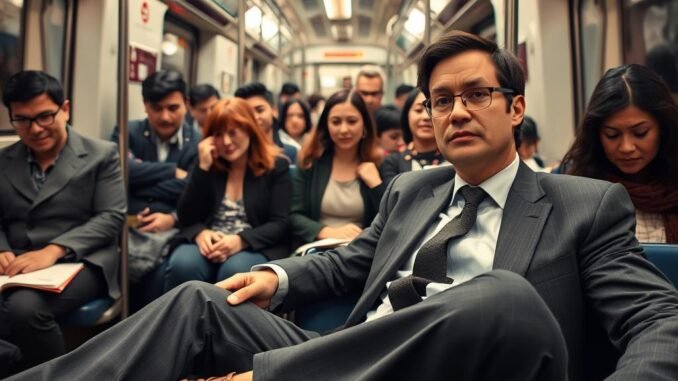
In New York’s rush-hour 4 train, one person’s wide stance can block two seats. This adds up to a dozen riders left standing. The debate over manspreading keeps coming back. It’s not just about what manspreading is. It’s about space, power, and being polite in crowded places.
Oxford Dictionaries defines manspreading as sitting wide and taking up more space than you should. This definition has set the stage for discussions by news outlets and transit agencies. The topic gained more attention in 2013 and 2014, thanks to viral Tumblr posts and posters from the MTA.
Seattle’s Sound Transit also joined in, spreading the message. By 2017, Madrid’s Municipal Transport Company banned taking more than one seat. This shows how a hashtag can lead to policy changes.
In the United States, The New York Times, Reuters, and CNN covered the topic. They talked about science, etiquette, and enforcement. People wondered about the meaning of manspreading and asked for a fair way to share space.
This series explores manspreading with expert views and personal stories. It looks at posture, comfort, and design. It also considers respect for our bodies and our neighbors. The main question is: How can everyone fit comfortably and politely when the bus is full?
What Is Manspreading? Definitions, Origins, and How the Term Took Off
Many people wonder what is manspreading because it’s common on buses and trains. It means sitting with knees wide apart, taking up too much space. Some call it man splaying, and others ask what is man spreading when they see legs spread into a neighbor’s seat.
Manspreading definition from Oxford and online dictionaries
OxfordDictionaries.com added the term in August 2015. It defines manspreading as men sitting with legs wide apart on public transport. This takes up space meant for others. Major online dictionaries agree, highlighting the behavior, location, and impact on others.
This helps people understand the manspread meaning. Naming the act also shapes how we talk about transit etiquette in cities and online.
Where the term originated and early Tumblr campaigns in 2013–2014
The term started on Tumblr in 2013 with posts and photos. In 2014, it spread to Twitter, Facebook, and Instagram. Mainstream outlets like Reuters noticed the trend.
As people discussed it online, the term became more serious. It led to discussions about seat sharing in public spaces.
How transit etiquette posters in New York and Seattle amplified awareness
In late 2014, New York’s MTA put up ads saying, “Dude, stop the spread please!” Around the same time, Seattle’s Sound Transit had ads saying “One body, one seat.” The New York Times and The Telegraph reported on these efforts.
Philadelphia and Chicago saw fewer complaints, but Toronto’s TTC focused on general reminders. Coverage continued as policies changed. CNN noted Madrid’s 2017 ban on taking more than one seat. These ads made the term familiar to many riders.
Is It Physiology or Entitlement? What Science and Experts Say
The debate on manspreading often falls into two sides: biology and behavior. There isn’t a well-known manspreading study yet. But experts point to biomechanical reasons for how people sit in tight spaces. They also see manspreading as a social issue, making it hard to find a simple answer.
Pelvis width, femoral neck angle, and comfort differences in sitting
Spinal neurosurgeon John Sutcliffe told The Independent that pelvic structure affects posture. Females have a wider pelvis and a more acute femoral neck angle. This makes men find sitting with knees together uncomfortable.
Fitness journalist Lou Schuler said forcing knees together can cause pain. This pain can lead to the legs opening up. An expert overview also mentions that pelvic rotation can ease strain for both sexes.
Testicular compression and why knees-together can feel stressful
Sutcliffe also said a wider stance can reduce pressure on testicles. Small adjustments, like a slight pelvic tilt, can help without taking more space. On moving vehicles, a wider stance helps balance better.
These physical factors don’t ignore good manners. They help explain why people sit differently based on their body type. So, manspreading’s meaning is about comfort, balance, and the situation.
Limits of current research and absence of definitive scientific studies
Despite these theories, there’s no clear manspreading study. The evidence is a mix of expert opinions, clinical insights, and small studies. This leaves room for culture and manners to influence how we see it.
As research gets better, the debate will continue. People look at body language, seat design, and comfort. They seek data to understand if manspreading is a habit or a natural behavior.
| Factor | Possible Physiological Note | Everyday Impact | Social Read |
|---|---|---|---|
| Pelvis width | Relatively wider in females; affects hip alignment | Men may feel less ease with knees touching | Can be misread as disregard for neighbors |
| Femoral neck angle | More acute angle linked to thigh trajectory | Knees-in posture can feel tight or pinchy | Appears like a deliberate spread |
| Testicular compression | Pressure from adductors when knees together | Wider stance reduces discomfort | May conflict with courtesy in crowds |
| Center of mass | Higher with more upper-body mass | Broader base aids balance on buses and trains | Looks like expansive posing |
| Seat and vehicle motion | Low lateral support increases sway | Legs brace outward to stabilize | Interpreted as manspreading body language |
Manspreading in Public Places: Subways, Buses, and Beyond
Rush hour compresses choices. Cars fill up fast, and every inch counts. Small movements can change someone’s ride. Riders talk about man spreading and manspread as they look for space.
Why crowded transit amplifies space conflicts
Trains and buses get packed, and space gets tight. People move to stay balanced. Small actions can block others when it’s full.
The New York Times said the MTA talks about being polite. It’s not just a pose; it’s a choice that affects others.
How seat and vehicle design affect body posture and leg position
Seat width and shape affect how we sit. Narrow seats and little support mean knees touch. Riders angle their legs to stay steady.
Designs at doors and ends matter too. Curved shapes or high floors push hips forward. This affects how people spread out.
“One body, one seat” rules and courtesy expectations
Agencies use simple signs to set rules. Seattle’s Sound Transit says “One body, one seat.” Philadelphia and Madrid also have rules to keep things fair.
These signs help riders sit compactly and respect others. It’s about fitting in and being polite: keep your space and let others have theirs.
From Hashtag to Policy: Campaigns, Bans, and Enforcement
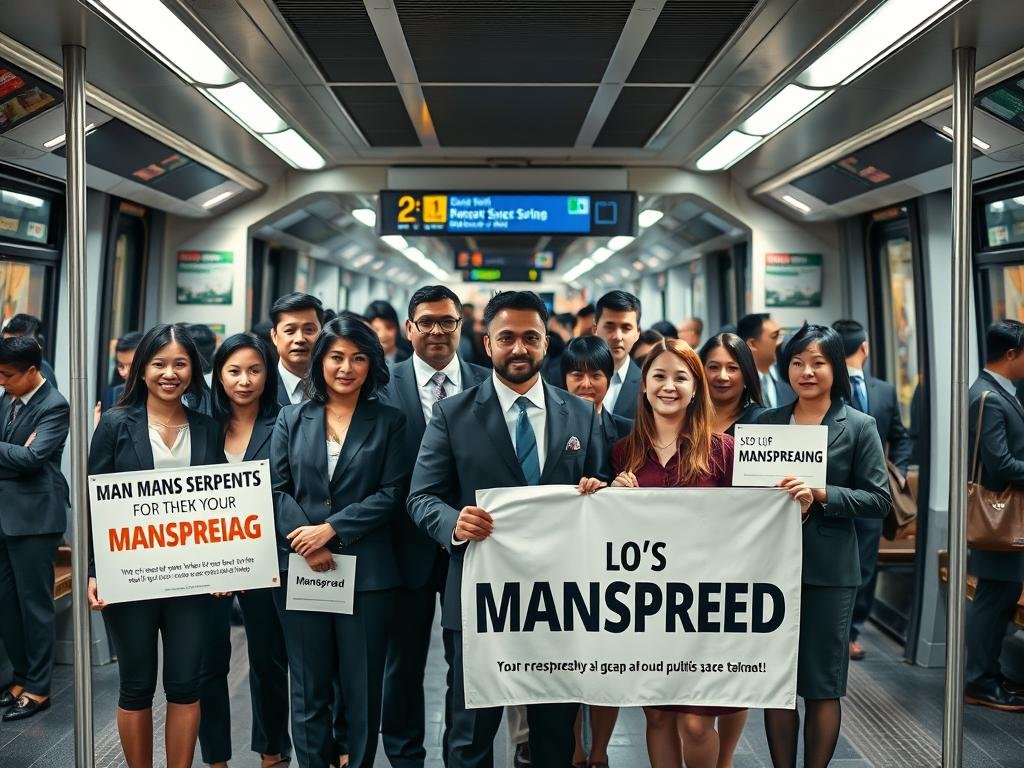
Transit agencies moved the debate from tweets to turnstiles. Riders asked what is manspread and what is manspreading in practical terms. Agencies answered with posters, bylaws, and etiquette reminders that offered clear manspreading examples tied to everyday commutes.
MTA’s “Dude, stop the spread please!” courtesy push
In 2014, New York City’s MTA rolled out the line “Dude, stop the spread please!” in a courtesy ad series. The message framed what is manspread as a seat-sharing issue, not a culture war. It ran alongside reminders about bags and feet, showing manspreading examples that commuters recognized on packed trains.
That same year, Seattle paired friendly graphics with similar advice. Together, the campaigns made what is manspreading a mainstream transit topic. Coverage by The New York Times helped the phrase jump from social feeds to station walls.
Madrid’s public bus ban on taking more than one seat
Madrid pushed further in 2017. The Municipal Transport Company adopted a rule against occupying more than one seat after a petition by Microrrelatos Feministas gained momentum. CNN reported the change as a standout policy move, sparked by everyday stories and manspreading examples shared online.
The city’s signage, including the #MadridSinManspreading icon, sat beside no-smoking and no-feet-on-seats notices. For riders comparing what is manspread versus general seat-hogging, the rule drew a bright line. For broader context on public campaigns, see this transit newsletter roundup.
Controversies over enforcement, including arrests and equity concerns
New York’s enforcement record stirred debate. Reports by HuffPost, The Independent, National Review, and Inverse noted arrests linked to MTA rules, raising questions about broken windows tactics and impacts on Latino men. A teen cited for keeping a backpack on a seat showed how posture and belongings can blur into the same offense.
Elsewhere, approaches differ. Toronto’s TTC shied away from a manspreading ban and stressed general courtesy, leaving what is manspreading to norms. These contrasts help riders parse manspreading examples from broader etiquette and assess how rules shape behavior.
| City | Primary Approach | Signature Message | Enforcement Style | Notable Outcome |
|---|---|---|---|---|
| New York City (MTA) | Courtesy ads and rules | “Dude, stop the spread please!” | Rule-based citations; reported arrests | Nationwide debate on equity and policing |
| Madrid (EMT) | Formal ban on taking more than one seat | Iconic no-manspreading signage | Policy-backed reminders | Petition-driven change with clear rules |
| Seattle (Sound Transit) | General etiquette campaign | Friendly graphics against seat-hogging | Social-norm pressure | Aligned with broader courtesy efforts |
| Toronto (TTC) | Courtesy guidance, no specific ban | One rider, one seat | Advisory, not punitive | Focus on rider-to-rider norms |
Manspreading Body Language and Social Signals
Manspreading is about more than just sitting. It’s about how we show respect and confidence. When we spread out, we send messages about our status and comfort.
Expansive poses, dominance, and attraction findings
Studies from UC Berkeley show that men who spread out are seen as more attractive. In photos, 87% of women found these men interesting. This shows that spreading out can be a sign of power.
But, for women, sprawling can mean different things. It might show they’re open or not safe. On the other hand, sitting tight can seem composed. This shows how complex body language can be.
Gendered perceptions of leg-crossing and posture
Leg-crossing is often seen as feminine and positive for women. But for men, it can be seen as weak. This shows how body language can change based on gender and culture.
These signals are learned, so they can change depending on the situation. This makes it hard to define manspreading in a simple way.
When posture reads as confident versus inconsiderate
An open stance can look relaxed in a quiet place. But in a crowded area, it can be seen as rude. People notice when someone takes up too much space.
It’s all about the situation. Manspreading can show confidence, but it also affects others. The meaning of manspreading depends on where you are and who you’re with.
Manspreading Examples, Reactions, and Stranger-Shaming Online
Social media turned scattered manspreading examples into a viral trend. People debated what manspreading is and how a single photo can be misleading. The meaning of manspreading often changed based on the situation, the design of the seat, and the person’s intentions.
In 2013, Tumblr started sharing photos of riders without their permission. These posts aimed to teach about etiquette, but they made people identifiable. This raised concerns about privacy, even as users argued the images showed clear breaches of courtesy.
Non-consensual photos, privacy worries, and comparison to creepshots
Scholars, like Emma A. Jane, pointed out how call-outs can be both activism and spectacle. Critics compared these posts to creepshots because they often focused on the crotch area. Supporters believed documentation proved a point, while opponents saw it as public shaming without consent.
Newsrooms struggled with whether a photo captured behavior or a body. They also wondered if sharing these images spread harm by increasing their reach. These debates highlight the need to understand what manspreading is and why it matters to everyone.
Public figures called out and context that gets missed
Celebrities were also targeted. Actor Tom Hanks was caught taking up two seats, but later explained the car was half empty. This shows how a single photo can miss important details like time of day, crowd levels, or disability.
Coverage in The Independent and Elle detailed the backlash and defenses. Readers saw how manspreading examples can simplify complex situations, leading to misconceptions about what manspreading is.
The ethics of documenting behavior in public spaces
Public spaces are visible, but dignity is important. Riders may not expect to be photographed, labeled, and archived online. Some photographers blur faces; others remove metadata; many do not.
Consent, harm, and necessity are key questions. Is the goal safety, etiquette, or viral content? Adding context, like crowding, seat width, or mobility needs, helps keep the focus on education, not punishment.
| Issue | What Viewers See | What Context Adds | Potential Impact | Better Practice |
|---|---|---|---|---|
| Non-consensual Photos | Legs wide, two seats used | Empty car, short ride, injury | Shaming, misidentification | Ask consent, blur faces, note setting |
| Focus on Crotch | Close crop of lap area | Camera angle chosen for effect | Voyeur tone, privacy concerns | Wider frame, behavior not body |
| Celebrity Call-Outs | Famous rider spread out | Half-empty car, off-peak hour | Viral pile-on, lost nuance | Add time, crowd level, seat type |
| Definition Drift | Any wide posture flagged | Design flaws, mobility limits | Overreach, stereotype risk | Clarify whats man spreading with examples |
| Archiving Posts | Perma-record of a moment | Behavior may be atypical | Long-term stigma | Remove identifiers, allow appeals |
Why Do Men Manspread? Competing Explanations People Debate
People wonder why men manspread in tight seats and busy aisles. The reasons vary from body mechanics to social cues. A manspreading study is often mentioned, but opinions are mixed. It’s unclear if men spread their legs for comfort or to signal something.
Biomechanics, torso length, and center of mass on moving vehicles
On buses and subways, legs act like a tripod without side bolsters. A wider stance helps balance as the car moves. Men often have more upper-body mass, making balance harder without support.
Longer torsos can swing like pendulums on turns. Spreading knees helps stabilize. Resting forearms on thighs also makes the shoulders appear narrower. This view sees manspreading as a way to stay balanced.
Cultural norms, gender expectations, and learned behavior
Posture also sends a message, critics say. Lyndsay Kirkham suggests it’s about learned confidence or entitlement. A manspreading study might show how boys and men adopt expansive poses as a sign of authority.
Commuters follow what they see rewarded. If a wide stance is accepted, it becomes a habit. This explains why men manspread even in tight spaces.
Geography and anatomy variations (hip impingement, dysplasia)
Anatomy affects some riders. Hip impingement and dysplasia can limit movement. These conditions make tight knee angles painful.
Reduced range of motion can lead to discomfort in narrow stances. For some, manspreading is the only comfortable option. Yet, a study linking anatomy to posture is hard to find.
The debate rages on from Reddit to local transit forums. Commuters consider stability, social cues, and anatomy with every move.
Manspreading Etiquette: Practical Ways to Share Space
Transit agencies and etiquette experts share simple tips for tight spaces. People often wonder about manspreading’s intent. But, the real solution is about how we sit and where we place ourselves.
Think about who needs the next seat. In crowded cars, being polite is key. Cities like New York, Seattle, Philadelphia, and Toronto all agree: adjust your posture and let others in.
How to sit parallel instead of in a V-shape when crowded
Keep your knees together and feet under the seat. Point your toes forward, not outward. Sit back and slightly bend at the hips, keeping knees shoulder-width apart.
When the bus stops or turns, hold steady with your core. Use a light grip on a pole. Only spread out when the car is empty. This is how you follow manspreading etiquette without discomfort.
Alternatives for bags and belongings to free up seats
Put backpacks on your lap or between your feet. Briefcases should go vertical, not sideways. Use overhead racks if you can, and avoid blocking the aisle with bags.
Philadelphia’s “Dude It’s Rude… Two Seats — Really?” campaign shows that a bag can take up a seat. This teaches us that manspreading is about managing space.
Balancing comfort needs with courtesy in peak hours
Stay within the seat’s limits for comfort. If it’s hard to sit tight, try a staggered foot position or a slight outward angle. Breathe and adjust your posture at each stop. Check if there’s room for others.
When more people get on, narrow your stance first. Then, tuck your belongings in. This approach helps everyone understand manspreading without feeling judged.
| Scenario | Recommended Action | Why It Works | Etiquette Reference |
|---|---|---|---|
| Crowded rush hour | Shift to parallel knees, feet under seat, bag on lap | Reduces encroachment and opens adjacent space | MTA courtesy guidance; Seattle transit posters |
| Moderate crowding | Stagger feet slightly, keep knees within shoulder width | Maintains comfort while respecting seat boundaries | Advice consistent with Peter Post’s manners guidance |
| Standing riders nearby | Compress posture; move belongings to floor between feet | Frees a seat and clears the aisle | Philadelphia “Dude It’s Rude” campaign |
| Empty car | Relax posture, then reset as passengers board | Comfort allowed, with awareness of changing conditions | General North American transit etiquette messaging |
| Tight seat design | Sit back, angle toes forward, avoid V-shape legs | Maximizes available width within the seat edge | Common best practices in manspreading etiquette |
Criticism and Counter‑Criticism: Is the Term Fair?
The debate over manspreading is more than just about sitting in public. It touches on power, space, and respect. For those asking, “What is manspread?”, this section explores the term’s impact across different views and why it’s a topic of debate.
Feminist and antifeminist critiques of the label
Writer Cathy Young sees the term as trivial and shaming. Journalist Jenny Yuen also criticizes campaigns targeting men as sexist. Men’s rights groups, like the Canadian Association for Equality, argue that tight sitting can hurt some men. They compare anti-manspreading efforts to limiting breastfeeding in public.
On the other side, Lyndsay Kirkham defends the term as a symbol of learned entitlement. Columnist Barbara Ellen suggests many men can sit normally without spreading. These views show how the term can be seen as fair or unfair, depending on who’s speaking.
Gendered framing versus universal transit etiquette
Some riders advocate for neutral rules that apply to everyone. They want to focus on shared rules like one seat per person. Advocates say the term should not overshadow basic courtesy: adjust your posture when crowded, keep aisles clear, and yield to those needing space.
Lake Superior State University banned “manspreading” in 2016, citing it as tired. Yet, calls for universal etiquette continue, showing the term’s enduring relevance.
“She-bagging” and parallel behaviors that take up space
Critics point out “she-bagging” as a similar issue. Campaigns in cities like Philadelphia target bags on seats alongside wide-leg sitting. The aim is to apply the same rules to all, making the manspreading definition part of a broader set of space-sharing norms.
In this context, manspreading is just one example of how people take up space. The term expands to include posture, belongings, and courtesy in crowded areas.
| Viewpoint | Core Claim | Representative Voices | Policy Implications |
|---|---|---|---|
| Antifeminist/Equity Feminist | The term shames men and overstates a minor issue. | Cathy Young; Canadian Association for Equality | Replace gendered labels with neutral comfort and health guidance. |
| Feminist Defense | The label highlights learned entitlement in shared spaces. | Lyndsay Kirkham | Keep the term to spark awareness while improving rider education. |
| Media/Commentary | Many men can sit without spreading; anatomy defenses are limited. | Barbara Ellen | Stress courtesy first; emphasize crowd-responsive posture. |
| Universal Etiquette | Focus on all space-taking behaviors, including “she-bagging.” | Philadelphia transit etiquette efforts | One-seat rules, clear signage, and consistent enforcement for all. |
| Public Fatigue | The word itself is overused, even if the issue remains. | Lake Superior State University (2016 list) | Use neutral language while maintaining crowding etiquette campaigns. |
Keyword note within narrative: manspreading definition, manspread meaning, and what is manspread are debated across these viewpoints, shaping how riders and agencies respond.
Media, Design, and Pop Culture Responses
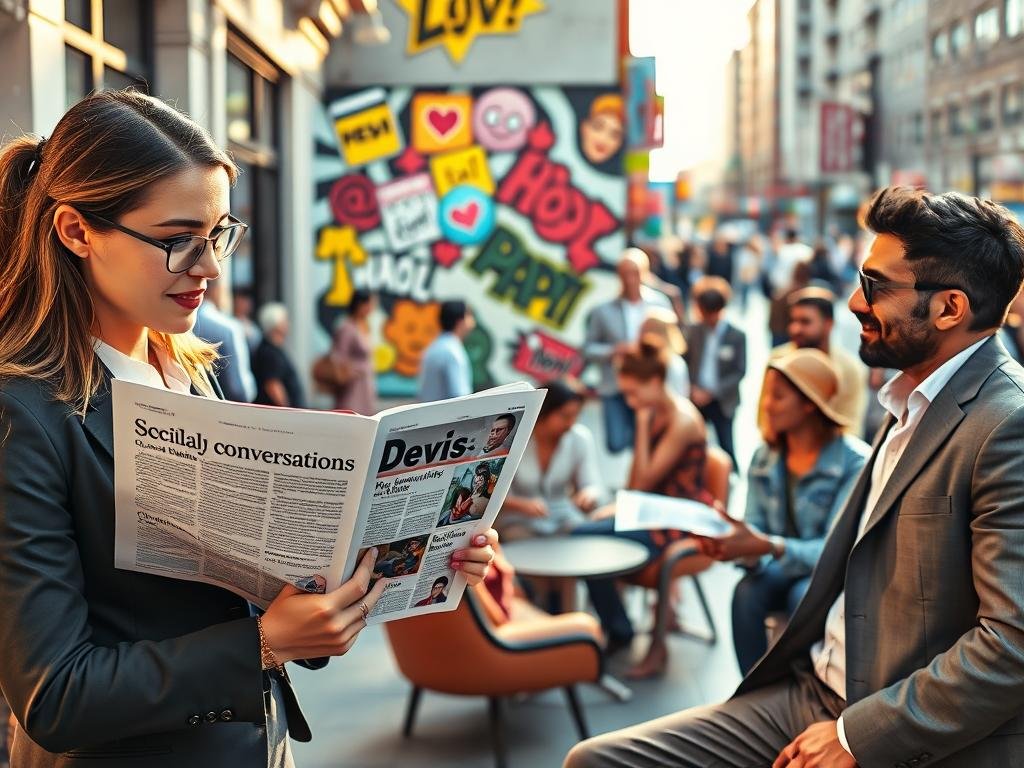
Headlines, classroom studios, and viral clips turned a transit habit into a broader cultural talk. Newsrooms tracked the manspread meaning, designers tested boundaries, and social feeds surfaced manspreading examples that people could debate in real time.
What sticks is the image: a seat, a camera, and a split-second choice about posture. That frame shapes how manspreading is judged in cities and on campus stages alike.
Anti-manspreading chairs and art-school provocations
In 2019, University of Brighton student Laila Laurel unveiled “anti-manspreading” chairs. One nudged men to bring knees closer; another invited women to claim extra space. The project won the Belmond Award and made headlines in the U.S., U.K., Canada, and Turkey.
The buzz showed how design can spark debate. Supporters praised a witty critique of posture norms, while critics called it hostile. For many readers, it clarified the manspread meaning more than a lecture could.
Words added to dictionaries and “banished words” lists
Language arbiters weighed in. OxfordDictionaries.com added manspreading in 2015, capturing the term’s rise from transit slang to mainstream speech. Soon after, Lake Superior State University put it on its 2016 “banished words” list, arguing the label had gone stale.
Coverage by The New York Times and Reuters cataloged these milestones. With each entry and list, the public gained a clearer map of usage, tone, and the boundaries of civility.
How viral videos shape public opinion on what’s acceptable
Mic’s 2015 New York subway video compared reactions to a woman versus a man spreading. The clip suggested women drew more stares, and the contrast fueled fresh manspreading examples across platforms. When a photo of Tom Hanks sitting wide made the rounds, his pushback highlighted context, like whether a car was crowded.
These bursts of attention act like pop-up polls. They do not settle the debate, but they guide how people read posture, proximity, and intent in shared spaces.
| Moment | Who/Where | What Changed | Impact on Public View |
|---|---|---|---|
| Dictionary Recognition | OxfordDictionaries.com (2015) | Added the entry for manspreading | Set a common manspread meaning and standardized usage |
| Word Pushback | Lake Superior State University (2016) | Placed the term on “banished words” list | Signaled fatigue and skepticism about the label |
| Design Provocation | Laila Laurel, University of Brighton (2019) | Unveiled anti-manspreading chairs; won Belmond Award | Global coverage reframed etiquette through design |
| Viral Video Test | Mic (2015) | Compared reactions to male vs. female spreading | Showed how gaze and judgment differ in practice |
| Celebrity Flashpoint | Tom Hanks, New York subway | Photo sparked debate; context defended | Reminded audiences that manspreading examples can omit conditions |
Together, media artifacts, design stunts, and dictionary notes form a feedback loop. They teach terms, spotlight behavior, and keep manspreading in view long after a commute ends.
Conclusion
The debate on manspread meaning is complex. It involves language, etiquette, biomechanics, and culture. Dictionaries added the term in 2015, after Tumblr posts and transit posters in New York and Seattle caught attention. Madrid even banned taking more than one seat in 2017.
Pop culture, art-school chairs, and viral clips kept the topic alive. They shaped how we view public space. People wonder why men manspread and what it means.
Some say it’s about pelvic width, femoral angles, and testicular comfort. Others see it as a status cue, habit, or learned norm. Research is mixed, with no single study proving a cause.
Enforcement stories, like arrests on the New York City subway, highlight the issue’s social stakes. Online call-outs add heat but sometimes miss the point. Non-consensual photos echo broader privacy fights and can lack context.
A better approach focuses on behavior, not blame. In crowded cars, keep legs parallel, move bags off seats, and follow the “one body, one seat” rule. This fits the science and courtesy most riders want.
As meanings evolve, so does our conversation about public space. Understanding manspread meaning, answering what is manspreading, and why men manspread can coexist with a simple rule. Be aware, share space, and adapt to context. This helps riders and cities find a fair balance, one commute at a time.
FAQ
What is manspreading?
Manspreading is when a man sits with his legs wide apart, taking up too much space. This usually happens on public transport. It was added to dictionaries in 2015 as a way to describe this behavior.
Manspread meaning vs. man spreading meaning—are they the same?
Yes, they mean the same thing. It’s about a person, usually a man, sitting with their legs spread wide, taking up more than one seat.
Where did the term manspreading come from?
The term started on Tumblr in 2013. It became popular on social media in 2014. By 2015, it was in the news and dictionaries.
How did transit posters in New York and Seattle popularize it?
In late 2014, New York’s MTA and Seattle’s Sound Transit ran ads. They asked men to stop spreading their legs. These ads made the issue more visible.
What is the manspreading definition from Oxford and other dictionaries?
OxfordDictionaries.com says manspreading is when men sit with legs apart, taking up too much space. Other dictionaries agree, focusing on the space issue.
Is manspreading about physiology or entitlement?
Both sides have arguments. Some say it’s about body comfort, while others see it as a sign of taking too much space. Experts say it depends on the situation.
How do pelvis width and femoral neck angle affect sitting comfort?
Men often have narrower pelvises and different hip angles than women. This can make sitting with knees together uncomfortable for some men.
Why can keeping knees together feel stressful for some men?
Sitting with knees together can be uncomfortable. It can cause muscle tension and discomfort in the hips and lower back.
Is there a definitive scientific manspreading study?
No, there isn’t a single study that proves why men spread their legs. Researchers have made guesses, but there’s not enough evidence.
Why do crowding and rush hour make manspreading a flashpoint?
When places are crowded, every inch counts. Wide legs can block others from sitting or make standing difficult. It’s about being considerate in tight spaces.
How do seat and vehicle designs influence leg position?
Narrow seats and swaying vehicles make riders spread their legs for balance. Larger riders may feel the need to spread their legs more. Better design can help avoid these issues.
What does “one body, one seat” mean in practice?
It means to keep your legs together and your belongings on your lap. Only spread your legs when there’s enough room.
What did the MTA’s “Dude, stop the spread please!” campaign do?
The MTA’s campaign reminded people to be considerate. It was part of a series of ads that encouraged good behavior without making rules.
Did any city ban manspreading?
Yes, Madrid banned taking up more than one seat in 2017. It didn’t target men, but the behavior of spreading out too much.
Why is enforcement around manspreading controversial?
In New York, arrests for seat-hogging were seen as unfair. Critics said it unfairly targeted Latino men and blurred the line between posture and bag-on-seat issues.
What does manspreading communicate in body language?
Wide legs can show confidence or dominance. But in crowded places, it can be seen as rude. It depends on the situation.
How do people read leg-crossing and other seated poses by gender?
Crossed legs are seen as feminine, while wide stances are masculine. These are cultural views, and reactions can vary.
When does a confident posture cross into rude?
When it blocks others or limits movement. A good rule is to shrink your space if someone is standing nearby.
What are common manspreading examples and reactions online?
Photos of men taking up two seats are common online. Reactions range from outrage to defense, depending on the situation.
Why are non-consensual photos a concern?
Photos of people without their consent, like in the early days of manspreading, raise privacy concerns. They can be seen as public shaming.
Have public figures been called out?
Yes, Tom Hanks was photographed sitting wide in a nearly empty train. It sparked debate about context and crowding.
Why do men manspread, according to competing explanations?
Reasons include body comfort, avoiding discomfort, and signaling dominance. Comfort and culture play roles.
Do torso length and center of mass matter?
Yes, they can. Larger upper bodies and longer torsos may make riders sway more, leading to wider sitting.
Can geography and anatomy differences influence sitting?
Yes, hip conditions can make sitting uncomfortable. Individual anatomy affects how people sit.
What are practical manspreading etiquette tips?
In crowded places, sit with knees together and adjust as needed. Keep belongings on your lap or between your feet.
Where should bags and backpacks go?
On your lap, between your feet, or on the floor. Don’t take up a seat with your belongings when others need it.
How can riders balance comfort with courtesy?
Sit neutrally in crowded areas and adjust as needed. This way, you can be comfortable without being rude.
Is the term manspreading fair?
Opinions vary. Some see it as a way to address unequal space-taking. Others call it sexist or unfair. It’s about being considerate in crowded areas.
Should etiquette be gendered or universal?
Most agree on universal rules like “one body, one seat.” This keeps the focus on shared space, not gender.
What is “she-bagging,” and why is it mentioned?
“She-bagging” is when women take up too much space with their bags. It shows that space issues aren’t just about men.
What are anti-manspreading chairs?
In 2019, a student designed chairs that encourage men to sit closer together. They sparked debate about design and social commentary.
How did dictionaries and “banished words” lists treat the term?
OxfordDictionaries.com added “manspreading” in 2015. Lake Superior State University put it on their 2016 list of words to avoid.
Do viral videos change public opinion on manspreading?
Yes, they can. Videos like Mic’s 2015 subway video show different reactions to men and women spreading their legs. They shape public views.
What is manspreading etiquette in public places beyond transit?
The same rules apply in waiting rooms, stadiums, and cafes. Keep your knees and elbows in your seat and adjust as needed.
Is manspreading the same as man splaying?
Yes, “man splaying” and “manspreading” are used to describe the same behavior. It’s about sitting with legs spread wide enough to take up too much space.
Be the first to comment