

At 464 pounds, Desmond Watson is 84 pounds heavier than the draft-day marks of Trent Brown and Daniel Faalele. This gap changes how we see size in football. Watson, a 6-foot-6 defensive tackle from the University of Florida, is making waves in the NFL draft.
In Gainesville, Watson showed incredible strength, hitting 36 reps at 225 pounds. He also ran a 5.93-second 40 and jumped 25 inches vertically. Without a combine invite, Watson impressed Florida coach Billy Napier with his smarts, humor, and team presence.
Across 51 games, Watson never missed a snap. He made 63 tackles, four tackles for loss, and 1.5 sacks. His viral one-yard fullback rumble in the Gasparilla Bowl win over Tulane made headlines. Despite hopes of being picked on Day 3, Watson went undrafted and signed with the Tampa Bay Buccaneers, becoming the league’s heaviest player.
Watson’s profile is unique among NFL draft prospects. He has historic mass, surprising lift numbers, and a clean availability record. Whether his record-setting weight will be an advantage or a challenge remains to be seen. It’s changing how teams view Watson’s NFL draft journey from Gainesville to the pros.
Why Desmond Watson’s historic weight matters for NFL draft history
Desmond Watson, at 464 pounds, is a standout in the NFL draft. His size could change how teams value players on Day 3. Any draft profile for him must consider his size, role, and how teams spend their picks.
Heaviest draft pick context and records to beat
Trent Brown and Daniel Faalele are the heaviest at 380 pounds. Watson’s 464 pounds is 84 pounds more than them. He even beats Aaron Gibson’s 410 pounds. This is highlighted in a report on his journey.
| Player | Height | Weight | Draft Status | Notable Benchmark |
|---|---|---|---|---|
| Desmond Watson | 6’6″ | 464 lb | Desmond Watson NFL Draft (2025) | Heaviest prospect entering the league |
| Trent Brown | 6’8″ | 380 lb | 2015, Round 7 | Tied heaviest drafted at 380 lb |
| Daniel Faalele | 6’8″ | 380 lb | 2022, Round 4 | Tied heaviest drafted at 380 lb |
| Aaron Gibson | 6’6″ | 410 lb | 1999, Round 1 | Previously the heaviest NFL player |
How weight and role at nose tackle influence team fit
Teams see Watson as a big player who can block double teams. He can also help in short-yardage plays. But, his size means he needs to stay in shape and control his snaps.
Projected late-round interest versus undrafted signing scenarios
Without a combine invite, Watson needed to impress at Florida’s pro day. He did with his bench press numbers. This kept him in the late Day 3 draft talk and opened up free-agent options. Teams often choose between drafting him or signing him as an undrafted free agent.
Desmond Watson prospect profile and background
Desmond Watson is a standout in college football. He has rare size and a steady presence. His profile highlights his mass, length, and quickness for a nose tackle.
Coaches and teammates admire his humor, smarts, and team-first attitude. These qualities are key in the desmond watson nfl draft outlook.
Size and measurables: 6-foot-6, 464 pounds at Florida’s pro day
At Florida’s pro day, Watson measured 6-foot-6 and 464 pounds. Billy Napier noted his unique combination of length, mass, and density.
This size makes him a formidable anchor in the line. It also shapes the desmond watson nfl draft conversation around his role.
High school to Gainesville: Armwood HS to Florida Gators
Watson moved from Armwood High School to the Florida Gators. This journey helped him become a trusted interior player.
He learned to occupy two gaps and free linebackers. His growth from high school to college grounds the desmond watson nfl draft case in steady development.
Durability and availability: never missed a game in four seasons
Watson played in 51 games without missing one from 2021–2024. His availability at his size is rare. It shows his routine, recovery, and commitment.
Teammates praised his quick feet and disruption at nose. His reliability is key to his prospect profile and keeps him in late-round talks for the desmond watson nfl draft.
| Attribute | Detail | Relevance to NFL Role |
|---|---|---|
| Height/Weight | 6’6″, 464 lbs (Florida pro day) | Elite mass for two-gap nose; controls centers and guards |
| Background | Armwood High School to Florida Gators | Proven path from Florida prep power to SEC trenches |
| Durability | 51 games, no missed contests (2021–2024) | Reliable weekly availability for interior rotations |
| Intangibles | Intelligence, humor, team-first approach | Locker-room fit; coachable presence on early downs |
| Trait Highlights | Anchor strength, surprising short-area nimbleness | Suits run-stuffing assignments and goal-line packages |
Desmond Watson college stats and on-field impact
Desmond Watson brought size and effort to Florida’s interior. He controlled the A-gaps, not always showing flashy numbers. Yet, his production is key in desmond watson draft talks and how scouts view nose tackles.
Desmond Watson college stats show he was always ready and valuable in certain situations. Coaches used his size to block run lanes and keep linebackers free. This is seen more on film than in stats.
Career production: 63 tackles, 4 TFL, 1.5 sacks in 51 games
In 51 games, Watson had 63 tackles, four tackles for loss, and 1.5 sacks. His goal was to reset the line, absorb force, and shrink space. This skill keeps him in the draft conversation as a true nose tackle.
These numbers help understand his draft outlook. He’s seen as a specialized run defender.
| Category | Number | Context | Implication for Draft |
|---|---|---|---|
| Games Played | 51 | Four seasons of availability | Durable depth with early-down utility |
| Total Tackles | 63 | Steady production from nose | Reliable run fits and pile control |
| Tackles for Loss | 4 | Disruption through leverage and mass | Situational value on short yardage |
| Sacks | 1.5 | Limited rush role by design | Scheme-dependent upside |
Signature plays: forced fumble vs. South Carolina, viral fullback carry
Watson’s tape is highlighted by a few standout plays. In 2022, he forced a fumble from Jaheim Bell of South Carolina and ran downfield before being stopped by Spencer Rattler. He also stopped South Florida’s Brian Battie in a viral play, showing his power.
In the 2024 Gasparilla Bowl, Watson played as a jumbo fullback. He helped Florida get a one-yard first down against Tulane. These moments add to his appeal and highlight his college stats.
Role definition: space-eating nose tackle and short-yardage jumbo looks
Watson played as a 0-tech, anchoring double teams and closing gaps. This allowed linebackers to flow freely. He also played in goal-line and heavy packages on offense, using his size and speed to push forward.
This role-focused profile shapes the desmond watson draft picture. He’s seen as a reliable option for early downs, heavy sets, and field-position snaps. His size and strength are key in these situations.
Pro day performance versus NFL combine benchmarks
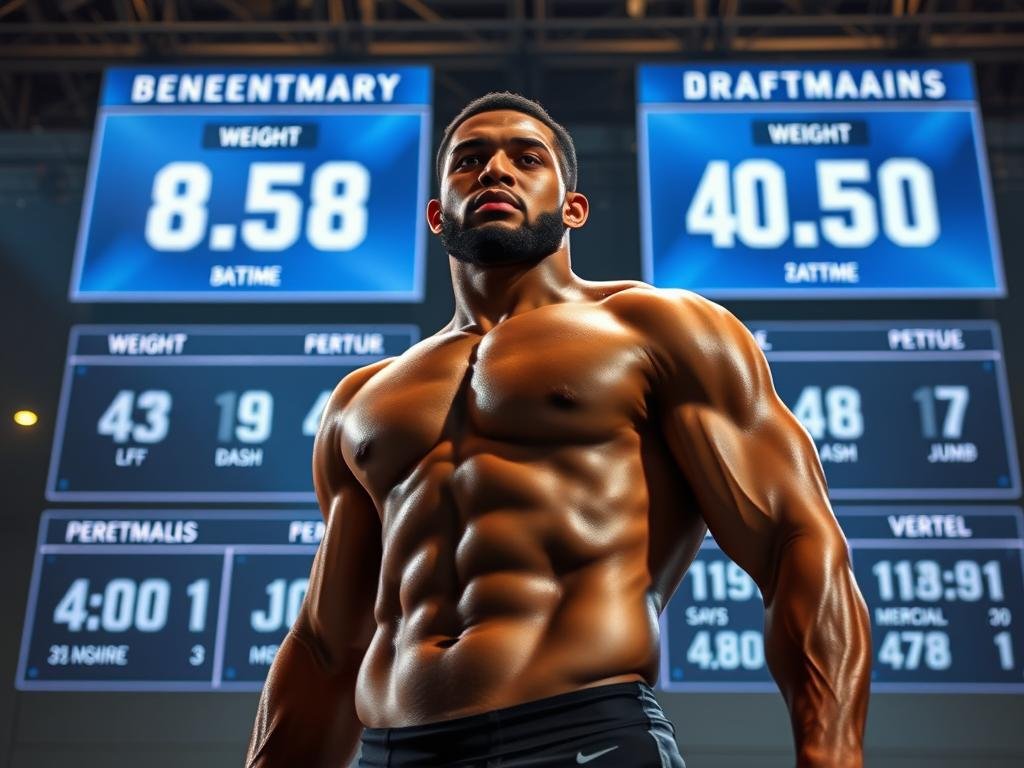
Florida’s pro day became a key event for Desmond Watson. He didn’t get an NFL combine invite. But his pro day numbers are now a big part of his draft profile. They show his power and speed, even at his size.
36 bench reps at 225: better than any 2025 combine result
Watson did 36 reps at 225 pounds, beating the 2025 combine leaders. This shows his strength and ability to hold his ground. It’s a key part of his draft profile that coaches can use.
5.93-second 40 and 25-inch vertical: movement at extreme mass
He ran a 5.93 in the 40 and jumped 25 inches. These numbers are good for someone his size. They show he has the speed and power needed for the NFL.
Scouts’ reactions and teammate endorsements
Scouts were impressed with Watson’s strength and ability to reset pockets. His teammates praised his quickness and ability to block. This feedback supports his draft stock and keeps him in the spotlight.
Desmond Watson scouting report
The scouting report on Desmond Watson focuses on his size, shock power, and clear role. Teams are looking at him as a niche run-stopper with unique traits. This view also shapes the draft analysis on him.
Strengths: rare mass, power at the point, anchor against double teams
At 6-foot-6 and 464 pounds, he’s a force in the middle. His size lets him handle double teams and reset the line. He also blocks A-gaps effectively.
His strength is evident in short yardage. He uses his leverage to create space for linebackers. This skill is a key part of any scouting report on him.
Areas to improve: conditioning, pad level, pass-rush plan and stamina
His conditioning is a key area for improvement. He tires visibly late in games, affecting his play count. A lower pad level is essential for his height, to maintain leverage against quick centers.
His pass rush needs work. With only 1.5 career sacks, he must develop a solid plan. Improving his hand technique and finishing moves could elevate his draft status.
Best schematic fits: 3-4 nose, 4-3 shade in early downs and goal line
His best fit is as a 0-tech in a 3-4 defense. He excels at drawing double teams and opening up blitz paths. He also works well as a 1-tech shade in a 4-3 defense, ideal for early downs and goal line situations.
Coaches can use him in jumbo sets, even as an occasional lead blocker. This approach will help him stay effective throughout games. Among NFL draft prospects, his role clarity is key to maximizing his impact.
Desmond Watson draft analysis and projection
At the start of the 2025 cycle, Desmond Watson was seen as a borderline pick. He didn’t get a combine invite and his stats were modest. Teams thought he was a niche prospect, valuable only in certain roles and with better conditioning.
Power moved the needle. Desmond’s 36 bench reps at 225 pounds started new talks about his strength and force. This performance changed how teams saw him, focusing on his value for early-down run defense and a true nose.
Yet, most scouts kept their hopes low. They thought he might go in the seventh round as a flier. Some even thought he might not get drafted at all, which could give teams more control over how he fits into their scheme.
After the draft, Desmond’s path matched the cautious projections. He wasn’t picked and signed with the Tampa Bay Buccaneers as an undrafted free agent. He joined the team at 464 pounds, bringing a unique mass to a front that values strong interior play.
Comparing Watson to past heaviest NFL draft picks
Size is key in the NFL draft. Desmond Watson’s 464 pounds changes how teams plan. His draft profile must consider history, role, and how size impacts games.
Trent Brown and Daniel Faalele at 380 pounds versus Watson at 464
Trent Brown and Daniel Faalele were around 380 pounds. They showed size can be a strength with the right plan. Watson, at 84 pounds more, needs to focus on quick, powerful plays.
Aaron Gibson’s 410-pound precedent and longevity lessons
Aaron Gibson was 410 pounds and taught a lesson on staying healthy. His story shows the importance of diet, rest, and training. Teams will use these lessons to keep Watson healthy all season.
Translating extreme size to sustainable NFL roles
Watson is best as a run stopper on early downs. He needs to pace himself with short plays and quick snaps. This approach keeps him effective without getting tired.
| Player | Listed Entry Weight | Primary NFL Role | Key Takeaway for Watson |
|---|---|---|---|
| Trent Brown | 380 lbs | Right/Left Tackle | Technique and conditioning can refine power at high mass. |
| Daniel Faalele | ~384 lbs | Right Tackle | Managed weight plus structured reps builds steady growth. |
| Aaron Gibson | 410 lbs | Right Tackle | Durability hinges on recovery, nutrition, and workload pacing. |
| Desmond Watson | 464 lbs | 0/1-Tech Nose Tackle | Focused early-down usage and strict oversight maximize impact. |
The Desmond Watson draft will test how teams handle extreme size. With the right plan, his strength can change games. A careful approach keeps him going strong in the fourth quarter.
Desmond Watson NFL combine absence and pro day spotlight
Not attending the NFL combine changed his path. Without an invite, he had to make every rep count. Every move in Gainesville had to speak louder than a week in Indianapolis.
Why the combine miss raised the stakes
The combine is key for verified stats and medical checks. It’s also where teams meet decision-makers. Missing it hurt a fringe candidate more.
For a 6-foot-6, 464-pound nose tackle, questions about conditioning and role fit grew. Without the showcase, his draft stock became tied to one day and witnesses.
How Gainesville testing put him on draft boards
Florida’s pro day was a game-changer. He did 36 reps at 225, ran a 5.93-second 40, and jumped 25 inches. These numbers impressed scouts who missed the combine.
Florida coaches and teammates backed him up. They saw him as an early-down anchor and short-yardage hammer. This made evaluators rethink his draft spot.
Impact on desmond watson draft stock entering late rounds
The pro day surge moved him into late-Day 3 talks. Some teams saw him as a priority if the seventh round was dry. This kept his draft stock alive until the end.
Though not drafted, the pro day opened a contract path. He quickly signed with the Tampa Bay Buccaneers. This move validated his late push in the draft.
| Event | Visibility | Key Metrics | Effect on Draft Outlook | Outcome |
|---|---|---|---|---|
| Combine (No Invite) | National, standardized | N/A | Limited exposure; fewer interviews and medicals | Pressure shifted to pro day; desmond watson nfl combine absence noted |
| Florida Pro Day | Targeted, team-heavy | 464 lbs; 36 bench reps; 5.93s 40; 25″ vertical | Late-round consideration rose; desmond watson draft stock improved | Entered desmond watson nfl draft discussions across multiple teams |
| Post-Draft | Team-specific decisions | Role: nose tackle, early downs | Priority free-agent interest materialized | Signed as UDFA with Tampa Bay Buccaneers |
Desmond Watson draft rumors and team fits
In the lead-up to the 2025 draft, rumors swirled about Desmond Watson. Teams wanted a player who could handle double teams and close gaps on early downs. His ability to anchor the defense and perform well on early downs was key. Yet, concerns about his conditioning and pad level were also raised.
After his performance in Gainesville, Watson’s hard work and agility caught the eye. This boosted his draft stock, with many teams showing late interest. He was seen as a seventh-round pick or a priority free agent, depending on the team’s needs.
Teams that run a lot and need help on short-yardage plays were interested. Tampa Bay, Pittsburgh, Baltimore, New England, and Tennessee were mentioned often. These teams saw Watson as a good fit for their schemes, focusing on his early-down skills and goal-line presence.
After the draft, Watson joined the Tampa Bay Buccaneers as an undrafted free agent. This move made sense for a team looking to use his two-gap skills. It also gave him a chance to work on his conditioning and technique in a structured environment.
- Ideal role: 0-tech in 3-4 and shade looks on early downs
- Immediate value: short-yardage, goal-line, heavy personnel packages
- Development focus: pad level, stamina, and rep-specific sequencing
Health, nutrition, and weight management trajectory

Any desmond watson prospect profile must track how size meets stamina. The staff at Florida aimed to turn raw mass into reliable snaps. This context also shapes desmond watson draft analysis and how teams view his runway in the desmond watson nfl draft.
Weight history: 385 as a freshman to 449 as a senior to 464 at pro day
Watson arrived in Gainesville at 385 pounds in 2021. He played near 415 as a sophomore, climbed to 435 as a junior, and was listed at 449 as a senior. At Florida’s pro day, the scale read 464, a number that informs the desmond watson prospect profile with clear year-over-year checkpoints.
These markers help scouts project conditioning blocks and snap pacing. They also frame desmond watson draft analysis as a balance between role value and weekly weight targets.
Coaches’ perspectives on habit-building and self-discipline
Head coach Billy Napier noted that multiple nutritionists, position coaches, and strength coaches aligned best in 2024. He stressed that Watson’s frame score, bone structure, and density will always keep the number high, so management must be targeted.
Watson has spoken about food cravings feeling like an addiction. This adds human context to the desmond watson nfl draft conversation. His honesty helps teams assess support plans and daily accountability.
Path to playable weight without sacrificing power
A practical path uses incremental weight checkpoints paired with conditioning blocks. The goal is to hold anchor strength while improving pad level and late-drive stamina. Early downs, short yardage, and jumbo packages can maximize value and keep workloads steady.
Placed within a desmond watson prospect profile, this plan aligns with how nose tackles age in the league. It also sharpens desmond watson draft analysis by linking role, nutrition, and workload to predictable outcomes in the desmond watson nfl draft.
| Season | Listed Weight (lb) | Program Focus | On-Field Usage | Management Takeaway |
|---|---|---|---|---|
| 2021 (Freshman) | 385 | Foundational habits; introduce nutrition protocols | Early-down reps, rotational | Establish baseline for conditioning blocks |
| 2022 (Sophomore) | 415 | Strength gains with controlled volume | Nose tackle anchor, short-yardage | Preserve power while pacing snaps |
| 2023 (Junior) | 435 | In-season maintenance and recovery windows | Goal-line and early-down emphasis | Reinforce pad level late in drives |
| 2024 (Senior) | 449 | Aligned staff plan on diet and routine | Package-based deployment | Targeted management over drastic cuts |
| Pro Day | 464 | Offseason recalibration with incremental targets | Projection: early downs, jumbo sets | Marry weight goals to conditioning phases |
This framework situates health and discipline at the center of role value, giving teams a clearer path to unlock impact without eroding the rare anchor that defines his game.
Conclusion
Desmond Watson’s journey from Armwood High School to Florida shows his determination and fit for the role. His performance at the Gainesville pro day was impressive. He lifted 464 pounds, did 36 bench reps at 225, ran a 5.93-second 40, and jumped 25 inches vertically.
These numbers highlighted his strength and power, not just his size. Despite going undrafted, Watson signed with the Tampa Bay Buccaneers. He became the league’s heaviest active player.
This outcome changes how we view Watson’s draft story. His size and strength are valuable, even if he’s not a traditional 0/1-tech. Coaches and teammates praise his intelligence, humor, and work ethic.
Watson’s college stats—63 tackles, four tackles for loss, and 1.5 sacks in 51 games—match his role. He excelled in blocking and showed flashes of skill, like a forced fumble against South Carolina and a memorable run in the Gasparilla Bowl.
Watson’s path forward is clear: maintain a low pad level, build stamina, and convert raw power into consistent plays. His size can give Tampa Bay an edge in the run game and on goal-line situations.
Be the first to comment