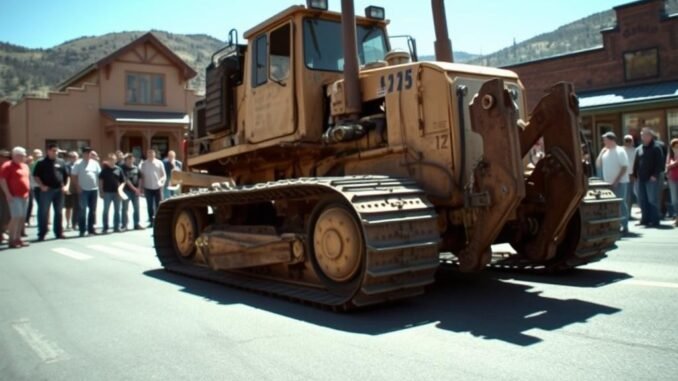
Thirteen buildings fell in just one afternoon, but amazingly, no one was killed. This event is shocking even 20 years later. On June 4, 2004, Granby, Colorado, saw a Komatsu bulldozer destroy buildings block by block. The Denver Post called it a “slow-motion rampage.”
Marvin John Heemeyer, a muffler shop owner, turned a bulldozer into a powerful weapon. The damage was estimated at over $5 million, possibly up to $7 million. The bulldozer was so well-protected that police thought it was “unstoppable and impregnable.”
Many wonder: who was Marvin Heemeyer, and why did his bulldozer incident shock the nation? Heemeyer became a symbol of local disputes over land use and code enforcement. His actions are seen as a warning about how anger can lead to violence.
Learning about Marvin Heemeyer starts with the facts. He built a special vehicle, planned his route, and changed Granby’s map forever. This article provides detailed information, exploring the events that led to the destruction of Main Street and the ongoing debate.
Overview of the Granby Bulldozer Rampage and Its Lasting Impact
In June 2004, a bulldozer made headlines in Granby, Colorado. It turned a peaceful town into a scene of chaos. The event became known as the killdozer rampage, leaving a lasting mark on culture.
The 2004 killdozer story blends spectacle with policy fallout. It sparked debates on emergency powers and property rights. Today, it’s a topic in local planning, school debates, and online forums.
Why the 2004 Granby, Colorado event is remembered nationwide
The killdozer incident was a mix of zoning issues and live TV drama. The bulldozer’s unstoppable image stuck with viewers. Social media later shared clips, making the event a symbol of policy and emotion.
For some, it’s about anger towards local government. For others, it’s about the danger of rage turned mechanical. This split keeps the 2004 killdozer in the national conversation.
Scope of destruction: 13 buildings, millions in damages, and zero non-perpetrator fatalities
In a few hours, 13 buildings were damaged or destroyed. The damage was in the millions, with insurance and lawsuits following. Despite heavy fire, no bystanders were killed during the rampage.
| Measure | Detail | Relevance to Public Memory |
|---|---|---|
| Structures affected | 13 buildings destroyed or severely damaged | Visible trail of damage anchors recall of the killdozer incident |
| Estimated losses | $5–$7 million in property and infrastructure | Economic shock sustains policy debates about town planning |
| Casualties | Zero non-perpetrator fatalities | Outcome fuels arguments on intent, risk, and restraint |
| Public utilities | Hits to transformers and service lines | Infrastructure strain deepened the sense of siege |
How “the Killdozer” became a viral cultural touchpoint
News footage showed the bulldozer’s strength and the town’s struggle. Blogs, forums, and documentaries like Tread spread the story. Memes, timelines, and clips kept the event alive.
As the footage was shared, the killdozer became a symbol. It’s now part of debates on civic trust, personal grievance, and the line between protest and destruction.
Background on Granby, Colorado and Local Zoning Tensions
Granby is in Grand County, just west of Rocky Mountain National Park. It’s a mix of ranch life and tourism. This setting influenced how people saw growth and heavy truck noise before the bulldozer incident.
People wonder about the killdozer, what pushed the town to the edge, and Marv Heemeyer’s role. These questions go back to Granby.
Granby’s small-town setting near Rocky Mountain National Park
Granby’s main street is for locals and visitors. It has jobs in lodging, dining, and shops for trail and lake travelers. This made land use decisions very personal, before the bulldozer story.
Rezoning for Mountain Park Concrete and community pressures
In the late 1990s and early 2000s, Mountain Park Concrete wanted to rezone near Marv Heemeyer’s shop. Heemeyer first wanted to sell his land for $250,000 to $375,000, then $1 million. When the sale didn’t happen, the company pushed for rezoning, causing more tension.
Property access, sewer line disputes, and code enforcement context
Heemeyer said the plant would make it hard to get to his shop and deliver goods. A sewer line would cost $80,000 and cross his property, adding to the conflict. He was fined $2,500 for junk vehicles and sent the payment with “cowards” written on it.
Early life, Air Force service, and move to Colorado
Marvin John Heemeyer was born in South Dakota in 1951. He joined the U.S. Air Force in 1971. After service, he worked in Denver and bought land in Granby for $42,000 in 1991-92.
He opened his muffler shop and lived alone. This period set the stage for the questions about who was killdozer and why the bulldozer became famous.
The Land, Sewer, and Code Disputes That Fueled the Conflict
Years before the heemeyer killdozer made headlines, a fight over land and utilities started. Marvin Heemeyer argued that the rezoning for Mountain Park Concrete would block his muffler shop. He lost appeals in 2001, leading to deeper conflict.
He faced fines for blight and was ordered to connect to the sewer. He claimed a town connection would cost about $80,000. When fined, he paid but wrote an insult on the check.
Talks with the Docheff family failed over price and access. He sued to block the concrete plant but lost. He also clashed with the local newspaper and proposed legalizing gambling, raising tensions.
In early 2003, he sold the property for about $400,000 but kept shed access. Inside, the marvin heemeyer bulldozer project was secretly being built. These months were key, as the paperwork battles and code letters were the fuse.
City files show the dispute involved zoning, easements, and infrastructure. The chain of events drew him deeper into grievance. This is documented on Marvin Heemeyer’s biography.
The conflict was never only about a driveway or a sewer line; it was about control, cost, and who gets to shape a small town’s growth.
The story of the heemeyer killdozer began with these civic steps. While some focus on armor and engines, the groundwork was laid in meetings and fines. This is where the marvin heemeyer bulldozer story began to harden, long before the rampage.
| Issue | Heemeyer’s Claim | Municipal/Counter Position | Key Dates | Outcome Relevance |
|---|---|---|---|---|
| Rezoning for Concrete Plant | Plant layout would block business access and devalue his property | Approvals moved forward after hearings with near-unanimous support | 2000–2001 | Anchored the killdozer story in land-use conflict |
| Sewer Hookup | Connection would require boring under plant property; cost near $80,000 | Required municipal hookup and fines for noncompliance | 2001 | Escalated tensions that fed what was the killdozer narrative |
| Lawsuit and Appeals | Sought to block the concrete plant and protect access | Court and administrative setbacks; approvals stood | 2000–2002 | Legal defeats increased grievance before marvin heemeyer died |
| Property Sale and Shed Access | Sold main property but retained access to a work space | New owner completed water and sewer connections | 2003 | Provided location where the marvin heemeyer bulldozer project continued |
Inside the “Killdozer”: Komatsu D355A Modifications and Armoring
The Komatsu D355A was at the heart of the Granby rampage. It evolved into the killdozer bulldozer that many talk about. The story of the killdozer starts with a heavy crawler, transformed by its operator into a sealed, armored vehicle.
In simple terms, the killdozer is a dozer turned into a mobile bunker. It’s known as the komatsu killdozer or killdozer komatsu. It combines massive strength with custom armor.
From bulldozer to fortified vehicle: steel, concrete, and sealed cabin
The Komatsu was strengthened with steel and concrete. This created a protective shell around the engine and operator. A separate roof was added, sealing the cabin completely.
This made the cabin quiet and protected from fumes. The armor also blocked bullets and debris. This transformation turned a work tool into a mobile bunker.
Camera systems, Lexan shields, and gun ports including a .50-caliber rifle
Without windows, cameras were used for vision. These were protected by thick Lexan. Air jets cleaned the lenses, allowing clear views for short times.
Gun ports were made for firearms, including a .50-caliber rifle. Yet, aiming was hard due to narrow openings and camera views.
Weight, power, and design trade-offs that limited precision
The added armor made the D355A much heavier. Its engine, around 410 horsepower, could move it slowly. But, the weight made it hard to maneuver.
The komatsu killdozer was powerful for ramming. But, its size and limited visibility made precise control difficult.
Why law enforcement described it as “unstoppable and impregnable”
Law enforcement tried many tactics, like armor-piercing rounds. But, the killdozer’s armor and mass made these efforts fail.
That’s why it was seen as “unstoppable and impregnable.” The killdozer komatsu showed its power by overcoming defenses, not by aiming well.
The June 4, 2004 Timeline: From Shop Exit to Immobilization
Around midafternoon, the sealed machine rolled out from a welded shop wall and onto Granby’s streets. Grease on its shell shed debris and small arms fire. The 2004 killdozer account begins here, with a fortified Komatsu most now call the granby bulldozer or heemeyer bulldozer, later labeled by many as the marvin heemeyer killdozer.
Initial targets at Mountain Park Concrete and pivot into town
The first strike came at Mountain Park Concrete. A grader tried to block the path, but the kill dozer shoved it aside. After circling the yard, the granby bulldozer turned toward downtown streets and picked up speed, heading for addresses tied to earlier disputes.
Damage to city hall, newspaper, utilities, and local businesses
The route cut through Granby’s core. City hall was hit, followed by the Sky-Hi News building, Mountain Parks Electric, a bank, a construction office, the police station, and the library. Gambles of Grand County took heavy damage. The heemeyer bulldozer also approached the former mayor’s home, leaving a trail that locals remember.
Shots fired at people, propane tanks, and transformers—and why explosions didn’t occur
Witnesses reported bursts from gun ports as the marvin heemeyer killdozer moved block to block. Rounds struck transformers and large propane tanks. Despite the risk, no major explosions followed, as angles, distances, and valve placement worked against ignition even while the kill dozer kept grinding forward.
How the dozer became stuck in a basement and the rampage ended
After roughly 90 minutes to more than two hours, the machine punched through the front of Gambles and dropped into the basement void. Tracks spun without purchase. Police and SWAT encircled the immobilized 2004 killdozer while smoke and dust settled around the granby bulldozer. Inside the sealed cabin, a single gunshot ended movement, and authorities later breached the armor to confirm the scene linked to the heemeyer bulldozer.
Law Enforcement Response and Emergency Decisions
Local officers arrived quickly and found a tough bulldozer. It ignored fire from rifles and shotguns. Colorado State Patrol units joined as the killdozer incident grew. Dispatchers sent out alerts to clear streets and warn families.
Emergency managers moved people block by block. The machine was heading towards public buildings.
Armor-piercing ammo didn’t work. A flash-bang in the exhaust was useless. Later, it was found that C4 couldn’t damage the vehicle’s strong shell. Crews said it was “unstoppable and impregnable.”
One sheriff tried to find a way in but couldn’t.
Command staff acted fast. They called Governor Bill Owens for help. Some officers wanted an Apache helicopter or an anti-tank weapon. But, there were worries about stray bullets in the town center.
Granby police kept evacuation routes open. They also cut gas and power to reduce danger.
Former SWAT commander Grant Whitus spoke out against heemeyer and the murder dozer. He said marvin heemayer was ready for deadly attacks. Troopers saw the Komatsu smash through walls while they guarded the area. The strong armor made the vehicle hard to see and move, affecting every decision that day.
Aftermath in Granby: Damage, Rebuilding, and Community Recovery
After the granby bulldozer rampage, people worked hard to clean up. The damage was severe, but neighbors came together. They brought tools, food, and time to help.
Even though marvin heemeyer died, the community focused on rebuilding. They worked to restore businesses and daily life.
City crews, volunteers, and shop owners coordinated repairs block by block, keeping utilities and storefronts on a steady path back.
Estimated losses exceeding $5–7 million and insurance realities
Early estimates said losses were over $5 million, with some near $7 million. Thirteen buildings were destroyed or badly damaged.
Insurance policies covered some repairs but not all costs. This left businesses with financial gaps for months.
Local business owners’ burdens and civic response
Businesses faced many challenges. They had loans, long waits for permits, and a shortage of contractors. The town focused on safety and reopening businesses slowly.
Donations and funds helped businesses. Volunteers also helped by clearing debris, allowing businesses to reopen faster.
Community cohesion and perspectives from local leaders and residents
Leaders emphasized calm and progress. Mayor Ted Wang said the community came together through shared efforts.
Parents, teachers, and first responders shared stories of returning to normal. They talked about sheltering children and guiding families home. These stories highlight the importance of neighbors over headlines.
| Area Affected | Known Impact | Recovery Focus | Notes |
|---|---|---|---|
| City Hall and Services | Operational disruption and facility damage | Continuity of permits, records, and public safety | Temporary offices kept core functions available |
| Local Newspaper | Office damage and publishing delays | Printing access and community updates | Regular briefings supported accurate reporting of the killdozer story |
| Retail and Hardware | Structural loss, inventory write-offs | Financing rebuilds and restocking | Owners balanced insurance payouts with loans after the heemeyer bulldozer attack |
| Utilities and Infrastructure | Lines, transformers, and access routes hit | Rapid restoration and hazard removal | Crews prioritized power, water, and traffic safety |
| Neighborhoods | Psychological stress and displacement | Counseling, shelters, and school support | Community groups organized aid as marvin heemeyer died and response shifted to recovery |
Public Perception and the “Folk Hero” Debate
After the killdozer incident, opinions quickly split. Some saw the killdozer guy as a hero against local power. Others wondered who he really was when lives were at risk. This debate continues to shape how we talk about Marv Killdozer today.
Online forums and T-shirts celebrate June 4 as “Killdozer Day.” They highlight that only the killer died. Yet, Colorado residents and police see it as planned violence. This shows the incident became a symbol for fights over authority and fairness.
Sympathizers versus critics: from “hero” claims to terrorism labels
Sympathizers argue the system pushed him to extreme measures. They say property rights fueled his anger. Critics, on the other hand, point out the armor, gun ports, and targeted attacks. They see him as a man ready to harm, not a vigilante. This is why many call it domestic terrorism.
Media, documentaries like “Tread,” and ongoing online narratives
Paul Solet’s film “Tread” brought the story back into the spotlight. It mixed police audio, local interviews, and footage of the machine. As more details came out, searches for who was Killdozer increased. YouTube debates and blogs kept Marv Killdozer in the public eye, fueling rival stories.
Quotes from former SWAT leadership and local journalists
Former SWAT commander Grant Whitus said the planning showed a clear intent to harm. He warned against glamorizing it. Journalist Patrick Brower, who reported in Granby, detailed the disputes and lawsuits that built up over years. Their accounts ground the story in facts, shaping how we remember the killdozer incident.
Where Is the Killdozer Now? The Fate of the Bulldozer
Many wonder: where is the killdozer now? After the 2004 rampage in Granby, officials had to decide what to do with the Komatsu. Their choice affects how the town deals with memory, safety, and unwanted attention.
where is the killdozer now and why it isn’t a tourist site
Some visitors hope to find a display or marker of the killdozer. But they won’t. Leaders in Grand County and Granby decided against a public exhibit. They feared it would attract crowds and glorify violence.
This choice kept the Komatsu out of museums and away from souvenir seekers.
Disassembly and disposal to prevent a shrine
Authorities dismantled the Komatsu and sent its parts to scrap yards. They were scattered to prevent a shrine. This move was to stop the Komatsu from becoming a symbol of violence or a place for fame seekers.
where is marvin heemeyer bulldozer now and related myths
Rumors say the machine is stored or in a private collection. But verified reports say it was cut up and dispersed. For those asking about Marvin Heemeyer’s bulldozer, the answer is the same as the killdozer’s: it was broken up.
The lack of a single artifact fuels myths. But it also makes rebuilding the machine unrealistic.
Keywords, Culture, and Commemorations: “Killdozer Day” and Internet Lore
Every June, the Granby event gets more attention online. People look up the killdozer story and wonder what it is. This interest spikes with new podcasts, blogs, or the film “Tread,” sparking debates.
killdozer story, what is the killdozer, and the rise of related search terms
People are curious about the basics. They want to know how the machine was built and what it looks like. As the story spreads, newcomers ask what the killdozer is to understand the facts.
2004 killdozer, granby bulldozer, and killdozer colorado in popular discourse
Geography plays a big role. Searches for 2004 killdozer, granby bulldozer, and killdozer colorado connect the event to a place and time. Each year, people reflect on the event and its aftermath.
killdozer komatsu, komatsu killdozer, and the machinery’s role in SEO searches
Technical details attract heavy-equipment fans. They look up the Komatsu D355A platform and its modifications. These readers compare specs and discuss the machine’s power and maneuverability.
who is marvin heemeyer and why the “killdozer guy” persists online
Questions about Marvin Heemeyer keep the story alive. Users revisit his story and the final hours. Forums celebrate “Killdozer Day” with memes and discussions, keeping the event in the public eye.
- Cultural hooks: anniversary posts, meme cycles, and documentary releases
- Common details revisited: sealed cab, camera shields, failed explosions, and recovery efforts
- Community angle: references to local damage, businesses, and the choice to prevent a shrine
| Keyword Theme | User Intent | Typical Follow-up | Notable Detail Recalled |
|---|---|---|---|
| what is the killdozer | Define the machine and event | Timeline and basic facts | Sealed cabin and camera system |
| killdozer story | Read a narrative recap | Motives and conflicts | Gun ports and Lexan shields |
| 2004 killdozer | Fix the date in history | Anniversary searches | June 4 observances |
| granby bulldozer | Connect to location | Maps and local context | Buildings and basement trap |
| killdozer colorado | Regional framing | Statewide impact | Utilities and public sites hit |
| killdozer komatsu | Identify brand and model | Specs and modifications | Komatsu D355A platform |
| who is marvin heemeyer | Profile the perpetrator | Background and disputes | Post-incident disposal |
Conclusion
The Granby story is unforgettable because it shows how a zoning fight can lead to rare violence. Years of disputes over rezoning and sewer access were the start. Marvin Heemeyer secretly built a Komatsu D355A into a powerful machine, now known as the granby killdozer.
Law enforcement called it “unstoppable and impregnable.” The rampage damaged or destroyed 13 buildings. It ended when the dozer fell into a basement, followed by Heemeyer’s suicide.
Details verified the truth behind the myths. The dozer had a sealed cabin, steel-and-concrete armor, and special features. These showed careful planning, not chaos. The weight made it hard to control, leading to its downfall.
For those near Rocky Mountain National Park, the damage was huge. Streets were closed, and rebuilding took millions. This shows how a local dispute can affect many.
People’s reactions are mixed. Some see the heemeyer killdozer as rebellion, while others call it domestic terror. Reports and the film “Tread” have challenged simple views. The machine was dismantled to avoid it becoming a shrine.
Yet, searches for what is killdozer and the phrase kill dozer keep the topic alive. People wonder about missed warning signs and choices made.
In the end, the granby killdozer is a warning. It shows how policy, pride, and planning can lead to tragedy. As communities discuss land use and code enforcement, Heemeyer’s case reminds us of the importance of early mediation and calm leadership.
This way, anger won’t find armor, and towns won’t have to rebuild their streets, businesses, and sense of safety.
FAQ
What was the Granby, Colorado “Killdozer” incident?
In 2004, Marvin John Heemeyer, a muffler shop owner, used a modified bulldozer to destroy 13 buildings in Granby. He had been in a long dispute over land use and zoning. The damage was over million, and Heemeyer died in the rampage.
Who is Marvin Heemeyer and why did he do it?
Marvin John Heemeyer was a welder and muffler shop owner. He moved to Granby in the early 1990s. He clashed with the town over zoning and code issues. He recorded tapes explaining his rampage as a response to perceived injustices.
What is the “Killdozer” and how was it built?
The “Killdozer” was a modified Komatsu D355A bulldozer. Heemeyer added armor and a sealed cabin. It had camera feeds and gun ports, but was hard to maneuver.
How many buildings were destroyed and what were the damages?
Thirteen buildings were destroyed or damaged, including City Hall and the police station. The damage was estimated at over million.
Did anyone beside Marvin Heemeyer die in the incident?
No. Despite the destruction, no one else died. The rampage ended when the dozer got stuck and Heemeyer died by suicide.
What weapons did Heemeyer use during the rampage?
Heemeyer used a .50-caliber rifle and handguns from inside the vehicle. He shot at people and buildings, but his shots were not very effective.
Why did the propane tanks and transformers not explode?
Heemeyer fired at them, but the equipment’s design and the dozer’s accuracy prevented explosions.
How did law enforcement try to stop the “unstoppable and impregnable” dozer?
Police used armor-piercing rounds and tried to find ways to stop the dozer. A sheriff even tried to climb on it. The dozer eventually got stuck in a basement.
Was the National Guard or military support considered?
There were discussions about using the National Guard. Some officers wanted heavier weapons, but it was decided not to use them in a populated area.
Where is the Killdozer now?
The Komatsu “Killdozer” was dismantled after the incident. Its parts were scattered to prevent it from becoming a shrine.
Where is Marvin Heemeyer’s bulldozer now and why can’t it be viewed?
The bulldozer was disassembled and scattered. This was done to avoid glorifying the rampage. It cannot be reconstructed or displayed.
What is “Killdozer Day” and why do people mark June 4?
“Killdozer Day” is a commemoration on June 4, the rampage date. Some see Heemeyer as a folk hero, while others call it domestic terrorism. It sparks debates and online discussions.
Why do people search terms like “what is the Killdozer,” “granby bulldozer,” or “killdozer Colorado”?
People search these terms around anniversaries and documentaries like Tread. They are interested in the machine and Heemeyer’s story.
What was the timeline on June 4, 2004?
Heemeyer mailed audio tapes and then drove through his shed wall. He targeted City Hall and other buildings. The rampage ended when the dozer fell into a basement.
How heavy was the armored bulldozer and how fast could it go?
The modified bulldozer weighed between 61.5 and 85 tons. It had a top speed of about 7 mph. The added weight made it hard to turn and aim.
What set off the conflict over land and access?
The conflict started when Mountain Park Concrete wanted to rezone near Heemeyer’s shop. Heemeyer opposed the zoning and sewer connections, leading to code disputes.
Did Heemeyer try to sell his property before the attack?
Yes, Heemeyer tried to sell his property for 0,000, then raised the price to
FAQ
What was the Granby, Colorado “Killdozer” incident?
In 2004, Marvin John Heemeyer, a muffler shop owner, used a modified bulldozer to destroy 13 buildings in Granby. He had been in a long dispute over land use and zoning. The damage was over $5 million, and Heemeyer died in the rampage.
Who is Marvin Heemeyer and why did he do it?
Marvin John Heemeyer was a welder and muffler shop owner. He moved to Granby in the early 1990s. He clashed with the town over zoning and code issues. He recorded tapes explaining his rampage as a response to perceived injustices.
What is the “Killdozer” and how was it built?
The “Killdozer” was a modified Komatsu D355A bulldozer. Heemeyer added armor and a sealed cabin. It had camera feeds and gun ports, but was hard to maneuver.
How many buildings were destroyed and what were the damages?
Thirteen buildings were destroyed or damaged, including City Hall and the police station. The damage was estimated at over $5 million.
Did anyone beside Marvin Heemeyer die in the incident?
No. Despite the destruction, no one else died. The rampage ended when the dozer got stuck and Heemeyer died by suicide.
What weapons did Heemeyer use during the rampage?
Heemeyer used a .50-caliber rifle and handguns from inside the vehicle. He shot at people and buildings, but his shots were not very effective.
Why did the propane tanks and transformers not explode?
Heemeyer fired at them, but the equipment’s design and the dozer’s accuracy prevented explosions.
How did law enforcement try to stop the “unstoppable and impregnable” dozer?
Police used armor-piercing rounds and tried to find ways to stop the dozer. A sheriff even tried to climb on it. The dozer eventually got stuck in a basement.
Was the National Guard or military support considered?
There were discussions about using the National Guard. Some officers wanted heavier weapons, but it was decided not to use them in a populated area.
Where is the Killdozer now?
The Komatsu “Killdozer” was dismantled after the incident. Its parts were scattered to prevent it from becoming a shrine.
Where is Marvin Heemeyer’s bulldozer now and why can’t it be viewed?
The bulldozer was disassembled and scattered. This was done to avoid glorifying the rampage. It cannot be reconstructed or displayed.
What is “Killdozer Day” and why do people mark June 4?
“Killdozer Day” is a commemoration on June 4, the rampage date. Some see Heemeyer as a folk hero, while others call it domestic terrorism. It sparks debates and online discussions.
Why do people search terms like “what is the Killdozer,” “granby bulldozer,” or “killdozer Colorado”?
People search these terms around anniversaries and documentaries like Tread. They are interested in the machine and Heemeyer’s story.
What was the timeline on June 4, 2004?
Heemeyer mailed audio tapes and then drove through his shed wall. He targeted City Hall and other buildings. The rampage ended when the dozer fell into a basement.
How heavy was the armored bulldozer and how fast could it go?
The modified bulldozer weighed between 61.5 and 85 tons. It had a top speed of about 7 mph. The added weight made it hard to turn and aim.
What set off the conflict over land and access?
The conflict started when Mountain Park Concrete wanted to rezone near Heemeyer’s shop. Heemeyer opposed the zoning and sewer connections, leading to code disputes.
Did Heemeyer try to sell his property before the attack?
Yes, Heemeyer tried to sell his property for $250,000, then raised the price to $1 million. He sold it for $400,000 but kept access to a shed for the bulldozer.
How did Granby recover after the bulldozer rampage?
Cleanup and rebuilding took months and years. Insurance gaps were a challenge, but community support helped. The town focused on resilience and rebuilding.
Why do some call Heemeyer a folk hero while others say terrorist?
Some see Heemeyer as a protest against government overreach. Others call it domestic terrorism. Former SWAT commander Grant Whitus and local publisher Patrick Brower reject glamorizing Heemeyer.
What role did the documentary Tread play in public opinion?
Tread brought national attention to the armoring and disputes. It sparked debates and changed some views as more facts were shared.
What is the “killdozer incident” best remembered for?
It’s remembered for the image of a fortified bulldozer destroying buildings. It caused millions in damage but no one else died. It’s a case study in how zoning disputes can lead to violence.
million. He sold it for 0,000 but kept access to a shed for the bulldozer.
How did Granby recover after the bulldozer rampage?
Cleanup and rebuilding took months and years. Insurance gaps were a challenge, but community support helped. The town focused on resilience and rebuilding.
Why do some call Heemeyer a folk hero while others say terrorist?
Some see Heemeyer as a protest against government overreach. Others call it domestic terrorism. Former SWAT commander Grant Whitus and local publisher Patrick Brower reject glamorizing Heemeyer.
What role did the documentary Tread play in public opinion?
Tread brought national attention to the armoring and disputes. It sparked debates and changed some views as more facts were shared.
What is the “killdozer incident” best remembered for?
It’s remembered for the image of a fortified bulldozer destroying buildings. It caused millions in damage but no one else died. It’s a case study in how zoning disputes can lead to violence.
Be the first to comment