

Granville Ritchie is asking for a second look at his case, a rare move in Florida. Only about 2% of death sentences get a new review. This move brings attention back to a major case in Hillsborough.
His request comes after the Florida Supreme Court ruled in June 2022. They said his death sentence was fair. But Ritchie believes mistakes were made during his trial that need to be fixed.
The case is connected to crimes in Tampa in 2014. A jury agreed to the death penalty. News outlets like the Tampa Bay Times and FOX 13 News have followed it closely.
Now, Ritchie’s appeal could change how Florida handles death penalty cases. It’s a chance to see if fairness can outweigh the need for finality.
Overview of the Hillsborough Penalty Case and New Review Effort
The penalty case against granville ritchie in Hillsborough County is back in the spotlight. Lawyers are asking for a new look at sentencing issues. This move comes after a big journey through the Florida Supreme Court and keeps Tampa news buzzing.
Why the case is back in the news
A petition for a new review has sparked renewed interest. Tampa news teams have been following the case closely. They’ve covered key moments and filings, keeping the public engaged in Hillsborough County.
Procedural posture: petition for new review after Florida Supreme Court ruling
The case is now at a post-judgment stage. After the Florida Supreme Court upheld the death sentence, granville ritchie’s lawyers filed an appeal. They argue for a review of penalty issues, despite the court’s previous ruling and denial of rehearing.
Key dates tied to appeals and rehearing denials
On June 9, 2022, the Florida Supreme Court confirmed the sentence. A denial of rehearing followed on August 23, 2022. The current appeal effort references these dates, highlighting why Tampa news outlets are keeping a close eye on the case.
Background: The Granville Richie Case and Timeline
The story of Granville Richie started in Florida, with key events in Tampa and Old Tampa Bay. It covers the crime, the investigation, and the trial. Prosecutors shared this with the jurors.
Events of May 16–17, 2014 in Tampa and Old Tampa Bay
On May 16, 2014, Granville Richie and his girlfriend, Eboni Wiley, picked up Felicia Williams in Tampa. They went to a drive-through and then to Richie’s mother’s apartment in Temple Terrace. Wiley said Richie gave her “Molly” and sent her for marijuana, leaving the child with him.
That night, Richie drove west across the Courtney Campbell Causeway. The next day, authorities found the body along the causeway’s north side. These events were key to the case as told in court.
Investigation, Arrest, and Indictment on Murder, Sexual Battery, and Aggravated Child Abuse
The investigation used witness statements, phone records, and travel paths. Detectives arrested Granville Richie in Florida for tracing his actions that night.
A Hillsborough County grand jury indicted him for first-degree murder, sexual battery, and aggravated child abuse. These charges reflected the investigation’s findings and were tested at trial.
Jury’s Guilt Findings: Premeditated and Felony Murder Theories
At trial, prosecutors argued both premeditated and felony murder theories. The jury found him guilty on all counts. They believed the killing was during the sexual battery and child abuse, and also premeditated.
The verdicts showed how the state framed the Granville Richie story. It was a serious crime in Tampa linked to Old Tampa Bay. The evidence was weighed by the jury under Florida law during a closely watched trial.
Evidence Summarized by the Trial Court
The case in granville ritchie florida focused on a tight timeline and confirmed movements. The court explained how witnesses, devices, and cameras captured key moments. These moments were later used at trial, leading to the defendant’s conviction.
Temple Terrace apartment events, drug use, and witness movements
Felicia Williams was at the Temple Terrace apartment with Granville Ritchie and Eboni Wiley, according to the court. Wiley left to get marijuana and was told to leave the child. This was because she didn’t have a driver’s license and had drugs.
While Wiley was away, an assault and strangulation happened inside. The defendant then hid the body and made up a false story. He told Wiley the child went to a nearby pharmacy for candy.
Later, he returned alone, put the body in a suitcase, and loaded it into his vehicle.
Cell tower data and red-light camera footage tracing travel across Courtney Campbell Causeway
Cell site records and red-light camera images tracked the vehicle from Temple Terrace to Tampa and toward Clearwater. The data showed late-night travel across the Courtney Campbell Causeway. Then, it took an exit to a north-side road hidden by heavy brush.
Investigators said this route matched the discarded suitcase and the hidden drop point. The court found this digital trail consistent with the defendant’s actions, supporting the trial’s sequence.
Discovery of the victim’s body in Old Tampa Bay
Law enforcement interviewed Wiley near the area and confronted her false story. She then admitted they were at the apartment and the child went missing. Officers detained the defendant soon after.
On May 17, 2014, the victim’s body was found in Old Tampa Bay. Physical evidence, phone records, and footage formed the evidence summarized by the court. The jury later convicted based on this evidence.
| Item | Location | Source | Relevance to Timeline |
|---|---|---|---|
| Witness accounts of apartment events | Temple Terrace | Sworn testimony | Places the victim and defendant together before the assault |
| Drug-related movements by witness | Tampa area | Trial record | Explains why the victim was left at the apartment |
| Cell tower connections | Temple Terrace to Clearwater corridor | Carrier records | Maps late-night travel toward the Courtney Campbell Causeway |
| Red-light camera images | Tampa and causeway approaches | Municipal traffic systems | Confirms vehicle path matching phone data |
| Body recovery details | Old Tampa Bay, north side shoreline | Medical examiner and law enforcement | Establishes endpoint of the route and supports the disposal narrative |
Penalty Phase Findings and Sentencing

After finding granville ritchie guilty in Tampa, the penalty phase began. It focused on aggravation and mitigation evidence. Jurors considered Florida’s sentencing options and listened to closing remarks before deciding.
Aggravators Found Beyond a Reasonable Doubt, Including HAC
The jury found three aggravators beyond doubt. They noted the victim was under 12, the murder happened during sexual battery, and it met the HAC standard. These findings made the death penalty eligible, and the panel decided aggravation outweighed mitigation.
Mitigating Circumstances and the Court’s Weight Assignments
At a Spencer hearing, no new witnesses testified. The court gave moderate weight to a lack of significant prior criminal history. It also gave moderate weight to accounts of mental and physical abuse by a father who was often absent.
Nonstatutory mitigation received little weight overall. The record mentioned a harsh upbringing in Jamaica, being the eldest among many siblings, steady work, and reports of kindness. Yet, the judge found the proven factors supporting HAC and related aggravators stronger.
Final Sentences: Death, Life Without Parole, and Consecutive Terms
The court sentenced granville ritchie to death for first-degree murder. For sexual battery of a child under 12 by an adult, the court sentenced him to life without parole. A separate term of 30 years was given for aggravated child abuse, with all terms running consecutively as part of the overall sentence for granville ritchie in Tampa.
Appeal Issues Raised in the Florida Supreme Court
The appeal issues focus on how closing remarks were framed, the limits of victim impact, and the handling of mitigation materials. The Florida Supreme Court looked at these points closely. They followed familiar standards, paying attention to preservation and any cumulative error that might affect the penalty phase for granville ritchie.
Claims about improper prosecutorial comments and “mercy” arguments
The defense argued against prosecutorial comments in the penalty-phase closing. They pointed out a mercy argument tied to the HAC factor. An early mention didn’t get an objection right away. Later, after more comments, counsel asked for a mistrial, questioning if mercy was shown to the victim.
The court told the State to only link mercy to HAC. No ruling was made on the mistrial request. The defense didn’t ask for a curative instruction. The Florida Supreme Court reviewed the unpreserved statements under fundamental error. They weighed their importance in the closing.
Challenges to victim impact evidence under Florida law
The defense also questioned the scope of victim impact. They argued about how Florida law allows such evidence but bars opinions on sentence. The Court looked at the challenged passages in context, including how jurors heard them during the penalty phase.
They analyzed if the victim impact was tied to lawful purposes or crossed into improper influence. Any prejudice was measured against the whole presentation.
Disputes over mitigation video redactions and rebuttal evidence
Another appeal issue was about mitigation. The trial court ordered audio redactions to a mitigation video and allowed rebuttal by the State. The defense said the edits weakened core mitigation and that rebuttal went too far.
Appellate review checked the redactions line by line and if the rebuttal was within bounds. The Florida Supreme Court evaluated the rulings under standard discretion review and their impact on the penalty phase.
Cumulative error arguments and preservation standards
The defense argued cumulative error, linking prosecutorial comments, victim impact, and mitigation disputes. The Court first looked at preservation standards, asking which objections were timely and which rulings were secured.
For unpreserved claims, the analysis turned to fundamental error. Only identified improprieties were considered in the cumulative error calculus. The focus was on their combined effect in granville ritchie’s penalty proceeding.
| Contested Point | Record Trigger | Preservation Status | Review Standard | Scope Considered |
|---|---|---|---|---|
| Prosecutorial comments and mercy argument | Multiple closing references tied to HAC | Mixed: one unobjected; later objection without ruling | Fundamental error for unpreserved; discretion for preserved | Entire closing and jury instructions |
| Victim impact | Penalty-phase statements under Florida law | Addressed within objections and context | Abuse of discretion; constitutional framing | Content, purpose, and effect |
| Mitigation video redactions | Audio edits to defense presentation | Preserved through motions and proffers | Abuse of discretion | Specific edits and jury exposure |
| State rebuttal to mitigation | Rebuttal following defense video | Raised during trial exchanges | Abuse of discretion | Match to scope of mitigation |
| Cumulative error | Combined impact of above | Dependent on preserved or fundamental findings | Cumulative analysis | Aggregate effect on penalty phase |
Florida Supreme Court Outcome and Next Steps
The case reached a key moment with a Florida Supreme Court ruling. The court upheld the convictions and sentence. Now, the focus is on whether a petition for review can overcome previous decisions and the court’s standards for error.
The latest filings deal with how the law views objections, the importance of evidence, and the range of appellate remedies.
June 9, 2022 opinion and August 23, 2022 rehearing denial
On June 9, 2022, the justices made their decision in SC20-1422. They looked at the evidence from the guilt phase under premeditated and felony-murder theories. The court kept the nonhomicide counts and explained its reasoning within state precedent.
On August 23, 2022, the court denied a rehearing. This move closed the direct appeal path. It also set a timeline for any future petition for review aimed at the same issues or new claims.
Fundamental error vs. preserved error: significance for review
Appellate review focused on whether each claim was a preserved error with a timely objection or fell under the stricter fundamental error test. This split determined the approach to issues like remarks about “mercy,” victim impact, redactions in mitigation videos, and rebuttal.
Fundamental error is rare. Advocates must show an issue is central to the case. If an issue was preserved, normal review applied. If not, the path narrowed, affecting cumulative arguments and the framing of the latest requests for relief.
What a new review would need to address
A new petition for review would have to deal with preservation findings. It would need to identify specific points that meet the fundamental error threshold or present new legal grounds not covered in the direct appeal. It would also have to explain how the penalty-phase claims, alone or together, meet Florida’s standards for relief.
Any filing should align the record with governing cases. It should show why earlier resolution does not control the outcome. It should also clarify how the latest arguments interact with the prior Florida Supreme Court ruling and the rehearing denial.
| Milestone | Date | Issue Focus | Review Standard | Implication for Next Steps |
|---|---|---|---|---|
| Opinion Issued (SC20-1422) | June 9, 2022 | Evidence sufficiency; penalty-phase claims | Preserved error vs. fundamental error | Defines baseline for any petition for review |
| Rehearing Denial | August 23, 2022 | Finality of direct appeal | N/A | Starts clock for latest collateral avenues |
| Preservation Findings | Embedded in opinion | “Mercy” remarks; victim impact; mitigation video; rebuttal | Fundamental error if unpreserved | Demands targeted, record-based showing |
| Potential New Review | Post-appeal stage | New legal grounds or clarifications | Cause-and-prejudice or fundamental error pathways | Frames scope and likelihood of relief |
Key People and Places Connected to the Case
The story revolves around a young girl named felicia williams florida and her connection to granville ritchie. It shows how Tampa and its roads played a big role in the timeline. Each person and place is important because they help us understand what happened and when.
Felicia Williams Florida Case Details and Family Impact
Felicia williams granville ritchie was left in his care at a Temple Terrace apartment. The next day, her body was found on the Courtney Campbell Causeway in Old Tampa Bay. Family members talked about missed birthdays and an empty chair at home.
These statements showed the lasting grief. They also linked the child’s name to Tampa and Temple Terrace, places that are part of daily life.
Eboni Wiley’s Testimony and Role in the Timeline
Eboni Wiley became a key witness. She said she was close to granville ritchie and that the child was at the apartment. Her testimony helped fill in the gaps from the evening to the early morning.
In Tampa, it was reported that Eboni Wiley wanted to clear up her story. Her account connected movements, calls, and the moments before the trip to the bay.
Locations: Tampa, Temple Terrace, and the Courtney Campbell Causeway
The story starts in Tampa, where pick-ups and short drives set the stage. It moves to Temple Terrace, the site of the apartment tied to felicia williams granville ritchie. Witness movements that night were also linked here.
The route then goes west toward Old Tampa Bay. The Courtney Campbell Causeway is the final stop. Its access road, bridges, and cameras helped investigators trace the events.
| Person / Place | Role in Timeline | Key Link | Notable Detail |
|---|---|---|---|
| felicia williams florida | Child at the center of the case | Ties events across Tampa and Old Tampa Bay | Recovery reported on May 17, 2014 |
| granville ritchie | Defendant connected to the apartment | Linked to Temple Terrace movements | Central figure in later appeals |
| Eboni Wiley | Witness shaping the sequence | Testimony about the child’s location | Account referenced in Tampa coverage |
| Tampa | Origin for pickups and stops | Urban routes feeding westbound travel | Anchor for calls and surveillance points |
| Temple Terrace | Apartment location | Connects felicia williams granville ritchie | Key site for late-night movements |
| Courtney Campbell Causeway | Discovery area in Old Tampa Bay | Final link in the route | North side access used as reference |
Together, these people and places shape a clear path through the facts, from neighborhood streets to the span over the bay.
Public Reaction, Media Coverage, and Courtroom Moments
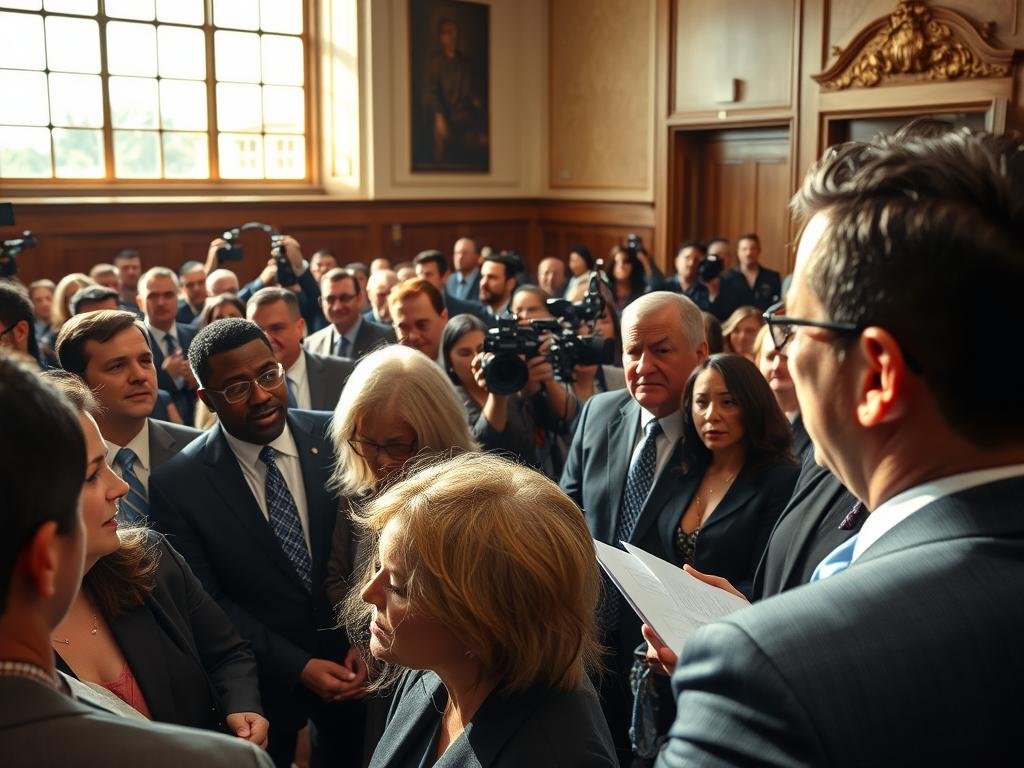
In Tampa Bay and Hillsborough County, the granville ritchie story caught everyone’s attention. People followed every update and hearing closely. Local news teams were right on it, capturing the mood inside and outside the courthouse.
Judge’s Emotional Sentencing Remarks: “May God Have Mercy on Your Soul”
The judge’s words, “May God have mercy on your soul,” were unforgettable. The courtroom fell silent, and many cried. This moment made the granville ritchie story even more impactful.
Reporters noted how the judge’s words changed the day’s news. The phrase was everywhere, helping Tampa Bay understand the case’s depth.
Community Response in Hillsborough County and Tampa Bay
In Hillsborough County, people mourned and vowed to move forward. They held vigils and shared memories. Leaders talked about safety and supporting families affected by violence.
Across Tampa Bay, people discussed justice and appeals. They followed updates to support the victim’s family and understand the legal process.
How News Outlets Covered the Latest Filings and Appeals
FOX 13 News focused on key moments and the judge’s words. Anchors highlighted the courtroom’s emotional atmosphere and the legal process.
The Tampa Bay Times looked at the case’s history and new filings. They connected recent developments to past decisions, making the granville ritchie story clear to readers.
| Outlet | Coverage Focus | Regional Impact | Notable Takeaway |
|---|---|---|---|
| FOX 13 News | Broadcast reports on hearings, sentencing tone, and reaction | Wide reach across Tampa Bay with real-time updates | Amplified the judge’s statement and gallery response |
| Tampa Bay Times | In-depth articles on filings, appeals, and witness timelines | Detailed context for Hillsborough County readers | Linked new motions to prior appellate milestones |
| Local Radio & Digital Briefings | Short bulletins summarizing new dockets and hearing dates | Quick hits for commuters across the region | Kept the case present in daily news cycles |
As filings continue, the community and its media keep a steady watch, ensuring the public record remains clear and accessible.
Latest Updates: Status, Questions, and Where the Case Stands Now
After the Florida Supreme Court confirmed the death sentence, everyone is curious about what’s next. People want to know where Granville Ritchie is now and if he’s alive. The Florida dockets show the pace, and the nation watches closely.
Where is Granville Ritchie now and is Granville Ritchie stil alive
He’s on Florida’s death row, according to corrections records. So, yes, Granville Ritchie is alive but under a death sentence. His status is detailed in official inmate systems, showing his current custody and the case’s current stage.
Pending petitions, potential federal avenues, and timelines
After the 2022 ruling, lawyers filed an appeal, including a petition for federal review. The certiorari filing raised constitutional issues. The timeline depends on Florida dockets and federal actions.
What can be appealed is key. This affects the strategy for future petitions. It’s important for understanding the case’s progress.
What to watch for in future Florida and federal court dockets
- Entries signaling next steps on Florida dockets, including motions tied to the record.
- Updates on federal review tracks, such as habeas petitions or new appellate filings.
- Scheduling notes that clarify briefing windows and response dates.
Media interest peaks with new filings. Checking official portals regularly helps track Granville Ritchie’s status and any new reviews.
| Track | Recent Focus | Key Documents | What It Could Mean Next |
|---|---|---|---|
| State | Post-affirmance monitoring on Florida dockets | Mandate issuance; rehearing denial entries | Signals if any new state motions arise or deadlines shift |
| U.S. Supreme Court | Questions tied to prosecutor remarks and constitutional claims | Petition for writ of certiorari; jurisdiction under 28 U.S.C. §1257(a) | Clarifies whether federal review proceeds or concludes at this stage |
| Federal Habeas | Potential filings after direct appeal and cert stage | Prospective petitions citing record-based and constitutional issues | Establishes briefing timeline and scope of claims |
Conclusion
The Hillsborough penalty case against Granville Ritchie is at a critical point. A unanimous jury voted for death. The court agreed, adding sentences for sexual battery and child abuse. The Florida Supreme Court backed this on June 9, 2022, and again on August 23, 2022.
Any appeal now faces tough challenges. It must meet strict rules and show clear errors in the trial.
Local coverage in Tampa has kept the case in the public eye. It highlights the human impact of the case. The victim’s mother’s words and the judge’s prayer add to the emotional weight.
Now, the focus is on whether a new appeal can succeed. It will depend on strict legal standards and a strong evidence base. The case is a test of how law and justice deal with tragedy and the quest for closure.
Be the first to comment