Helicopters to spray Dibrom insecticide over Tampa after dengue detected in mosquito traps
Helicopters to spray Dibrom insecticide over Tampa after dengue detected in mosquito traps
Helicopters will fly low over parts of Tampa and Town ‘N Country between Sept. 8 and Sept. 11 to spray Dibrom insecticide after surveillance traps detected dengue virus activity in local mosquito populations, according to Tampa Free Press. Hillsborough County Mosquito Management Services ordered the aerial treatments to knock down adult mosquito populations in the affected neighborhoods before the virus spreads further.
The announcement follows routine trap testing that flagged dengue virus in mosquitoes collected within county limits. Officials scheduled the flights quickly, giving residents only days of notice before spraying begins.
What triggered the spraying: dengue virus found in surveillance traps
Hillsborough County runs an ongoing mosquito surveillance program that collects and tests trapped mosquitoes for disease markers. When traps in specific zones came back positive for dengue virus, Mosquito Management Services classified the areas as active risk zones and authorized emergency aerial treatment, according to Tampa Free Press. That detection is what moved the county from routine monitoring to a targeted spraying response.
Dengue detection in mosquito populations doesn’t confirm a local human case on its own, but it signals that the virus is circulating in the insects capable of transmitting it to people. That’s why county officials acted on the trap data right away instead of waiting for confirmed illness reports.
Spraying schedule: Sept. 8-11 flights over Tampa neighborhoods and Town ‘N Country
The aerial treatments are scheduled to run from Sept. 8 through Sept. 11, covering several Tampa neighborhoods along with Town ‘N Country, according to Tampa Free Press. There’s no single blanket spray zone. The flights target the specific areas where surveillance traps returned dengue-positive results.
Which areas are included
Multiple Tampa neighborhoods fall within the treatment zone, alongside Town ‘N Country, an unincorporated community west of downtown Tampa, according to Tampa Free Press. The county’s mosquito control unit picked these locations based on trap data rather than a broader citywide sweep, so coverage is concentrated where dengue activity was actually confirmed.
Timing and low-altitude flight details
The helicopters will fly at low altitude overnight during the scheduled window, a standard method for adulticide spraying because it takes advantage of reduced wind and mosquito activity patterns after dark, according to Tampa Free Press. Residents in the affected neighborhoods should expect to hear and see aircraft overhead during these overnight hours between Sept. 8 and Sept. 11.
Dibrom insecticide: what it is and how aerial spraying works
Dibrom is the adulticide the county picked for this round of treatments, applied from helicopters flying at low altitude over the targeted neighborhoods, according to Tampa Free Press. Aerial adulticiding works by dispersing a fine mist of insecticide that contacts and kills adult mosquitoes on contact, reducing the population capable of biting and transmitting disease in the days right after application.
This method targets adult mosquitoes rather than larvae, making it a short-term knockdown tool rather than a long-term elimination strategy. Counties typically pair aerial adulticide runs with other larvicide and source-reduction efforts to keep populations down between spray cycles.
Safety guidance for residents during spray windows
County mosquito control programs that use aerial adulticides generally advise residents in treatment areas to stay indoors during active spraying and shortly after, and to bring in items like pet food and water bowls left outside. Following the specific guidance issued by Hillsborough County Mosquito Management Services for this spray window is the most direct way residents can limit unnecessary exposure while the helicopters are active over their neighborhoods.
Dengue fever in Florida: transmission, symptoms and current risk level
Dengue fever has become a recurring concern in Florida in recent years, as the state deals with another mosquito-borne viral threat. The Tampa spraying operation is a direct response to that pattern, triggered specifically by the dengue detection in local surveillance traps rather than a statewide outbreak declaration.
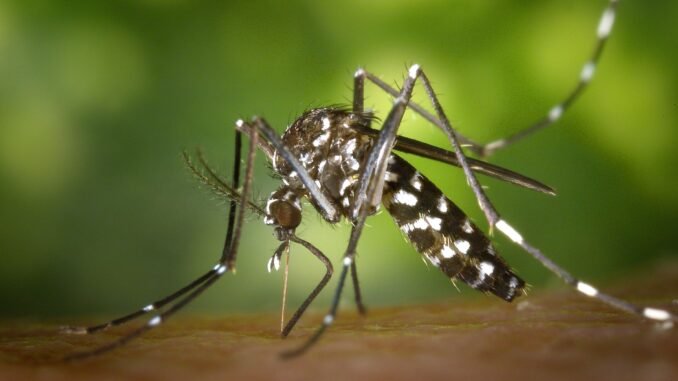
Dengue spreads to humans through the bite of infected Aedes mosquitoes, the same species targeted by the county’s spraying operation. Symptoms typically include high fever, severe headache, pain behind the eyes, joint and muscle pain, and rash. Most cases resolve without hospitalization, but severe dengue can develop and requires prompt medical attention.
How mosquito-borne dengue spreads locally versus travel-related cases
Florida distinguishes between locally acquired dengue cases, where a person is infected by a mosquito within the state, and travel-related cases, where someone contracts the virus abroad and is diagnosed after returning home. The dengue virus detected in Hillsborough County’s mosquito traps points to local circulation of the virus within the insect population itself. That’s the scenario that triggers aggressive vector control responses like aerial spraying, since an infected mosquito population can pass the virus to residents who have never traveled outside the region.
Hillsborough County Mosquito Management Services’ broader response
Hillsborough County Mosquito Management Services is the agency directing the response, from ordering the helicopter flights to setting the Sept. 8-11 schedule and identifying which neighborhoods need treatment, according to Tampa Free Press. The aerial spraying is the most visible piece of a mosquito control operation that runs continuously across the county, combining surveillance, larvicide treatment and periodic adulticide spraying.
Surveillance trapping and how officials decide where to spray
The county’s decision to spray specific Tampa neighborhoods and Town ‘N Country, rather than the entire county, stems directly from its trap network. Mosquito Management Services places and monitors traps across Hillsborough County, testing captured mosquitoes for disease activity. When a trap in a given zone tests positive, as happened here for dengue virus, that result triggers a localized aerial response rather than a broader county-wide treatment.
What residents should watch for next
Residents in the affected Tampa neighborhoods and Town ‘N Country should expect low-flying helicopter activity overnight through Sept. 11 as Dibrom spraying continues, according to Tampa Free Press. Anyone experiencing dengue symptoms, including high fever, severe headache, or joint and muscle pain, after potential mosquito exposure in the treatment zones should contact a healthcare provider promptly. Continued updates from Hillsborough County Mosquito Management Services will indicate whether additional trap detections extend the spraying schedule or expand it into new neighborhoods beyond the current Sept. 8-11 window.
Be the first to comment