

Only 1 in 20,000 bluefin tuna ever tops 800 pounds. Yet, Destin just saw one weighed at HarborWalk Marina. The 832-pound Gulf of Mexico catch was made after a four-and-a-half-hour fight about 160 miles offshore.
Captain Jake Matney, with deck mates Devin Sarver and Jett Tolbert, made landfall on April 17. The dock erupted when they arrived.
This is more than just Destin fishing news. Florida’s state mark is 826 pounds, 8 ounces, set by Rick Whitley in 2017. If verified, this fish edges that benchmark and inches toward a world record. WEAR captured names and timing, while HarborWalk Marina’s Facebook post sparked a surge of shares and comments across the coast.
The story touches the entire ocean ecosystem, from bait schools to apex predators. Anglers swapped notes on Instagram as the weigh-in wrapped. They compared the scale number to recent headlines, including a Destin-based 161.6-pound escolar landed in an Alabama tournament.
The region keeps producing vibrant fish species and shock-value weights. As buzz spreads, readers ask about everything from tackle to lesser-known species like the ruby red lips fish. For now, the focus is simple: a giant on the block, a community holding its breath, and a Gulf of Mexico catch that could reset the record books.
Breaking news from Destin: A massive bluefin tuna stuns anglers and onlookers
Destin buzzed with excitement as a huge bluefin tuna arrived at Destin HarborWalk Marina. Anglers and spectators gathered, eager to see the massive catch. This moment showcased the Gulf Coast’s underwater wonders and the excitement of catching rare fish.
Where and when the catch happened
The fishing trip started on April 15, heading deep into the Gulf of Mexico. The crew hooked the tuna 160 miles out, and the battle lasted 4.5 hours. On April 17, the tuna arrived at Destin HarborWalk Marina, where everyone waited with bated breath.
As the tuna appeared, the dock lights lit up the scene. Even the most experienced anglers were speechless. This moment was more than just a catch; it was a memorable event in the Gulf’s history.
Why this fish could make history
The tuna weighed 832 pounds, a record-breaking catch. It could surpass Florida’s previous record of 826 pounds, 8 ounces. If confirmed, this tuna would be a state record, making every measurement critical.
Every detail was important. The crew checked the gear, leader, and handling to ensure the catch was legitimate. Destin HarborWalk Marina was the stage waiting for official verification.
How news spread across the Gulf Coast fishing community
The news started with a Facebook post from Destin HarborWalk Marina. Local and national media soon followed, including WEAR and Fox News. Outdoor Life and Instagram reels helped spread the excitement.
Devin Sarver’s Facebook account added a personal touch to the story. At the same time, a 161.6-pound escolar was caught in Alabama. Anglers were captivated by these stories of deep-sea battles and rare fish sightings.
Inside the catch: The Destin offshore crew, their vessel, and the epic fight
Out past the shelf, a Destin offshore fishing crew ventured into the Gulf of Mexico. They were on the No Name boat, aiming for a deep sea giant. Their battle with a bluefin tuna showed their skill and teamwork in protecting vibrant fish.
The boat and team behind the haul
Captain Jake Matney and his crew were on the No Name boat. They had a setup for long runs and clear lines. Their experience across the Gulf helped them find the best spots for ocean fish.
Each crew member had a role. One watched the spread, another managed the drag, and the third cleared the way. When the bluefin tuna fight started, their plan was key.
Captain leadership and deck crew roles during the battle
Matney led the charge, guiding the boat and the angler. Devin Sarver managed the cockpit, keeping the lines tight. Jett Tolbert took care of tools and safety, ensuring everything was ready for the next move.
Their teamwork was flawless. They worked together, gaining ground and resting when needed. Their strategy was based on experience, keeping both the crew and the fish safe.
Timeline: From hookup to landing after hours of nonstop pressure
They set off on April 15, heading 160 miles out. The strike came early, turning the deck into a flurry of activity.
The battle lasted about four and a half hours. The crew kept up the pace, until the fish was ready to be landed. By April 17, the fish was back in Destin, a victory for the crew’s hard work and teamwork.
Record benchmarks: How this Destin catch compares to existing state and world records
Destin is buzzing about a record bluefin tuna. This catch could change ocean records. Anglers and officials are focusing on careful certification. They know every detail is important.
Florida bluefin tuna state record context
Florida’s record is 826 pounds, 8 ounces, set by Rick Whitley in 2017. The Destin fish weighs 832 pounds. If certified, it would beat the current record.
For a record bluefin tuna, officials check for species ID, intact condition, and scale paperwork. They log it into ocean ecosystem records.
All-tackle world record considerations and certification steps
For the global stage, IGFA rules guide every step. The angler must fight the fish without aid. The line class and leader must meet rules.
Photos and witness statements back up the story. Certified scales and time-stamped weigh slips complete the package. This aligns the claim with ocean ecosystem records.
Weigh-in, verification, and what officials look for
At HarborWalk Marina, weigh-in verification is key. Officials check the scale’s certification and inspect tackle and knots. They confirm species characteristics.
They also check for tampering and note the fish’s length and girth. This process is common for big-game claims, like bluefin or other vibrant fish species.
| Benchmark | Requirement | Destin Catch Implications |
|---|---|---|
| Florida State Record | Exceed 826 lb 8 oz; verified species; certified scale | 832 lb report clears weight threshold pending certification |
| IGFA All-Tackle Eligibility | Unassisted fight; rule-compliant gear; complete documentation | Needs full IGFA considerations review to advance |
| Weigh-In Protocol | Controlled site; weigh-in verification; audit trail | HarborWalk Marina process supports traceable records |
| Comparative Gulf Standards | Certified scales used in regional tournaments | Parallels practices that validate major catches across the Gulf |
The takeaway for anglers is simple: precise steps, verified gear, and clean weigh slips turn a giant into a verified record bluefin tuna.
Gulf of Mexico conditions: Why April offshore waters can produce giants

By mid-spring, the Gulf of Mexico is ready for action. Long runs to the blue waters are common. The Loop Current brings warm water across the deep, making temperature changes sharp.
Crews 150 to 170 miles offshore find clear water and tuna. Flying fish and tuna gather bait near rips. This creates a narrow path for feeding.
Stratified layers are key. A clear thermocline separates cool and warm water. This creates a vertical structure that holds forage in place.
When squid and hardtails gather, pelagic migration increases. Giant fish like bluefin and yellowfin follow. Sometimes, deep sea creatures like escolar hide below.
In April, the wind and current guide drifting baits and trolling spreads. The water changes color, showing plankton and oxygen shifts. This attracts ocean fish species.
Anglers see vibrant fish at dawn, then sound back to the layer where life concentrates. This pattern is seen across Destin offshore grounds.
Long-range corridors connect canyons, humps, and river plume edges. This keeps marine life moving. When the gradients stabilize, the bite is strong from sunrise to slack tide.
This is a brief but intense time. The underwater beauty and biomass peak together. The result is a spread of flying fish, blackfin, and bluefin.
Each pass over the seam tests your gear and endurance. When the water is right, the Gulf rewards patience with unforgettable encounters.
Destin’s HarborWalk Marina: The weigh-in scene and community reaction
People gathered at the dock as the Destin weigh-in started. They looked up at the catch and the shiny scales. The marina became a stage, filled with stories of the day’s fish.
Phones flashed as the dockhands made way. Some talked about a rare ruby red lips fish seen near East Pass. It was a reminder of the Gulf’s surprises.
Social media buzz and eyewitness accounts
HarborWalk Marina quickly shared photos and details on social media. The news spread fast, beyond Okaloosa County. People shared their views from the pier, causing excitement as the numbers appeared.
Anglers talked about the noise when the fish hit the sling. Families admired the fish’s shine and compared it to others in the Gulf. Charter crews were amazed by the rare sight of a Destin weigh-in.
“You could feel the dock vibrate when the weight settled,” one longtime mate said, describing the hush before the cheer. “HarborWalk Marina brings everyone into the moment.”
HarborWalk Marina’s role in record documentation
The marina’s weigh platform is key for recording big catches. Staff check the scales, note witnesses, and take photos. This helps prove the catch’s authenticity.
Crews bring tags and gear details ready. Officials focus on verification photos and measurements. In a place known for unique fish, HarborWalk Marina keeps each weigh-in organized.
| Weigh-In Element | HarborWalk Marina Practice | Why It Matters |
|---|---|---|
| Certified Scale | Regular calibration and documented checks | Supports accurate weights for record review |
| Witness Log | Names and timestamps recorded at the dock | Creates verifiable timelines and transparency |
| Photo & Video | Multiple angles posted via social media fishing news | Gives reviewers clear proof of condition and size |
| Fish Handling | Clean sling lifts and minimal contact | Preserves features compared with colorful saltwater fish references |
| Species Confirmation | On-site ID with backup images | Clarifies distinctions among unique fish species, including a ruby red lips fish when relevant |
As the sun set, the crowd left but the online buzz continued. The day’s photos from HarborWalk Marina will be shared for years to come. They remind us of the power of a Destin weigh-in and the Gulf’s vibrant colors.
Angler voices: Firsthand quotes from the boat deck and the emotion of a lifetime catch
On a heaving Gulf swell, the crew found their rhythm. Their angler quotes were short, sharp, and honest. The boat hummed under load as they balanced endurance fishing with calm, trained hands.
What they felt spoke to the wild edge of marine life. The bite, the run, the stubborn circles—each pass under the bow raised the pulse. It was adrenaline offshore with purpose, tempered by respect for fish that had earned every inch.
Adrenaline, endurance, and respect for the fish
Deck mate Devin Sarver put it simply on Facebook: he was grateful for the ups and downs of a fight shared with “great people.” He wrote that he had never felt so much respect for fish, calling the bluefin “as bad as they come,” and adding, “God is great.”
Those words matched the grind of endurance fishing. Hands cramped, backs burned, and yet the mood stayed steady. The crew kept focus while schools of vibrant fish species flickered in the wash, a living frame around a test of will in raw marine life.
How the team managed the final moments boat-side
When color showed, the mood shifted from story to checklist. Leaders cleared the gunnel, and gaff points were called out. Two gaffs went in on cue, followed by a tight tail rope as the fish surged off the quarter.
The captain held the line with small bumps of throttle. The anglers guided the head, then walked the body to the side doors. Thirty measured minutes passed before the team heaved together and the deck thundered. It was adrenaline offshore, contained by discipline—and framed by the same angler quotes that honored the fight and the marine life that defined it.
Parallel headline from the Gulf: Destin-based angler lands 161.6-pound deep-water escolar in Alabama tournament
A Destin angler on the Prime Time made a big catch. They caught a 161.6-pound deep-water escolar in the dark. This catch was a big deal, sparking talk of records and the IGFA all-tackle record.
Pre-dawn strike 120 miles offshore and the 800-foot battle
It started before dawn, 120 miles off Mobile. Live bait was crushed, and the fight began. The fish took nearly 2,000 feet of line.
The battle was tough, with the fish at 300 feet. After two hours, the crew pulled it to the boat. They used gaffs and a tail rope to bring it aboard, then iced it.
Certified weight versus Alabama state record for escolar
At the dock, officials weighed the fish on certified scales. It weighed 161.6 pounds. This beat the Alabama state record by a lot.
The team sent the paperwork to the state. They took measurements and photos. This catch was well-documented, proving its weight.
How this compares to the 173.75-pound IGFA all-tackle record
The IGFA all-tackle record for escolar is 173.75 pounds. This fish was close, but not quite there.
This catch shows the Gulf’s rich fish life. It shows how skill and luck can get close to the top. The Gulf’s fish diversity keeps getting better.
Postscript on preservation: The crew gave the fish to scientists for study. Artist Harley Van Hyning made a print to remember the moment.
Deep sea creature spotlight: What makes escolar unique among ocean fish species
In the Gulf of Mexico, the mix of blue water and steep drop-offs creates a stage for underwater beauty. Among these ocean fish species, escolar stands out for raw power and deep-water habits. It pushes into dark layers where forage stacks and currents shear, showing traits far from reef life and coastal edges.
Marine life and underwater beauty in the Gulf of Mexico
Escolar roams near the thermocline and makes long, crushing runs. It favors dense bait lines and sharp temperature breaks, which is common in the Gulf. This deep hunter shares the region with pelagic travelers and with reef fish that add color and contrast to the scene.
The result is a mosaic: sleek predators offshore and colorful saltwater fish on the ledges. That range keeps scientists and captains alert to shifts in currents, light, and bait schools.
Unique fish species with bright coloration, including wrasse fish
While escolar wears dark, muted tones, many reefs glow with bright coloration. Wrasse fish flash greens, blues, and oranges as they work cleaning stations. The Gulf hosts many unique fish species, from parrotfish to the ruby red lips fish seen in tropical waters, each adapted to light-filled shallows.
These contrasts highlight how ocean fish species split roles. Deep-water hunters rely on muscle and endurance; reef standouts use color and pattern to signal, hide, or court.
Colorful saltwater fish in marine aquariums versus wild tropical fish species
Home displays often feature marine aquarium fish that thrive in stable, warm tanks. Hobbyists favor hardy, colorful saltwater fish and wrasse fish that accept prepared diets and show vivid hues under LEDs. Their behavior is shaped by space and controlled flow.
In the wild, tropical fish face surge, predators, and competition. The ruby red lips fish, butterflyfish, and damsels reveal bolder range and complex schooling. Side by side with escolar’s deep realm, the underwater beauty of reefs completes a living spectrum across the Gulf’s ocean fish species.
Tactics and gear: The techniques that tame giants offshore
They use offshore tactics when the fish start biting a lot. They set up live baits at the bottom for deep drop fishing. They use a silent clicker and watch the rod closely.
They make long retrieves, lifting slowly and smoothly. When they hit a thermocline at 300 feet, they pause. Then, they make small gains.
For the long haul, they choose Shimano reels for their power and heat control. They use a rod belt or harness to distribute the weight. The captain keeps the boat steady.
They have gaffs and tail ropes ready. A side door makes it safer to get on the boat when the fish turns.
Boat and angler work together in the ocean ecosystem. They move calmly to protect the gear and the fish. This approach helps them catch vibrant fish species in the blue waters.
They follow record-ready habits. They prepare the certified scales before fishing. They have tags, tape, and cameras ready.
They log important details like leader length and reel model. They secure the fish for transport to a marina weigh station. This makes it easier to get the fish’s weight officially recorded.
When a big fish bites, they slow down. They lift with the swell and recover line on the fall. They keep the drag steady on Shimano reels.
The captain adjusts the pressure without losing the fight. The crew stays quiet and focused. In this rhythm, they can catch big fish and make unforgettable moments.
Conservation and science: Donating rare catches and studying marine life
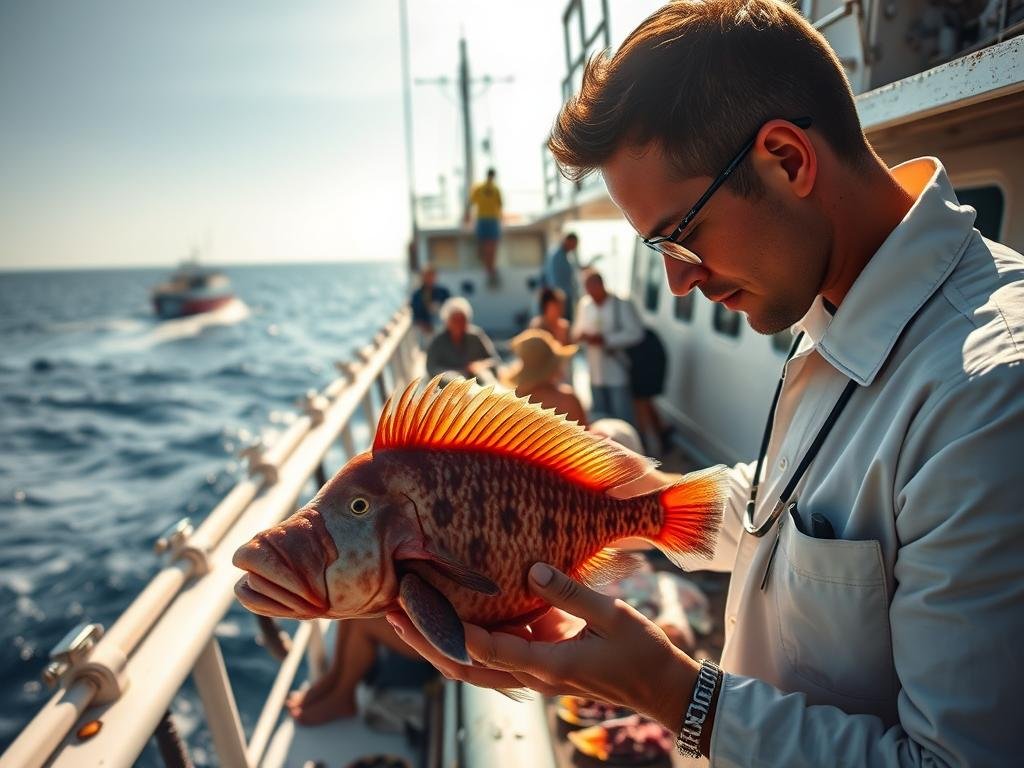
Destin’s big catches can help conservation when anglers donate them for research. Weigh-ins at HarborWalk Marina connect captains with labs. This helps study marine life in the Gulf and beyond.
Why large specimens matter to researchers
Big fish and deep sea creatures have unique data. Scientists study their bones, stomachs, and genetics. This helps understand the ocean and protect it.
Donations, like a 161.6-pound escolar, give insights into age and diet. They also help track fish species, showing trends in the ocean.
Best practices for ethical handling of deep-water and pelagic fish
Crews handle fish carefully to preserve them and the samples. They use gaffs and ropes to avoid damage. Quick icing helps for tests and age readings.
- Keep the fish wet and supported to reduce stress and bruising.
- Limit deck time; weigh and photograph quickly if records are pursued.
- Coordinate with marina staff so researchers receive intact organs and otoliths.
- Document location, depth, and gear, noting if a deep sea creature surfaced from extreme water.
Anglers in Destin balance documentation and welfare. Planning for donations before fishing helps. This way, they support conservation and marine studies.
Conclusion
Destin’s HarborWalk Marina saw a big moment when the No Name crew came back with an 832-pound bluefin tuna. Captain Jake Matney and his team, Devin Sarver and Jett Tolbert, caught it 160 miles out. They fought for 4.5 hours, a story shared on Facebook and WEAR.
If confirmed, this catch would beat Florida’s record of 826 pounds, 8 ounces. It shows how Destin tracks ocean fish with great care and detail.
Also, Taylor Guidry from Destin caught a 161.6-pound escolar in an Alabama tournament. This fish broke the state record and is close to the IGFA all-tackle mark. It’s a season of endurance, timing, and smart fishing.
Marinas, anglers, and researchers work together to study these big catches. They weigh, verify, and study them in real time.
The Gulf of Mexico is full of colorful fish, from hunters to deep sea creatures. People often ask about the ruby red lips fish because of its bright color. Each catch, like the bluefin or the ruby red lips fish, teaches us about the ocean.
This catch and the escolar show the Gulf of Mexico’s surprises. With careful handling and science, the coast turns news into knowledge. It opens the door for more adventures on the water.
Be the first to comment